



SORA’s XOR token has one of the more difficult price histories in crypto to interpret.
The original XOR price series reached an all-time high of $981.83 on April 6, 2021. Years later, however, comparing that price directly with the XOR quoted today produces a misleading picture. XOR’s supply expanded dramatically, its denomination changed inside the SORA network, its Ethereum representation was replaced, and SORA has since begun moving XOR into a new network architecture called SORA Nexus.
There is another complication: a reliable current circulating supply is difficult to establish from the major market-data services. The current XOR listing on CoinGecko reports a price and total supply but no circulating supply, while CoinMarketCap’s legacy SORA page displays materially different supply information and a 1,000,000:1 swap notice.
Understanding what happened to XOR therefore requires more than looking at a price chart. Its elastic supply, repackaging, cross-chain representations and ongoing SORA v2-to-Nexus migration all matter.
Key Findings
- The original XOR price series reached an all-time high of $981.83 on April 6, 2021.
- SORA v2 launched in April 2021 with 350,000 XOR, but XOR was designed with an elastic rather than fixed supply.
- XOR’s nominal supply later expanded into the hundreds of billions before SORA implemented a 100:1 repackaging in May 2025.
- The repackaging changed the denomination used inside SORA rather than proportionally destroying holder value.
- CoinGecko’s current XOR listing does not report a circulating supply, making a conventional circulating market capitalization difficult to verify from that dataset.
- The current Ethereum ERC-20 contract represents XOR returned to Ethereum through SORA’s HASHI bridge. Ethereum-side supply should not be treated as the complete economic supply of XOR.
- SORA Nexus Minamoto launched as a mainnet in April 2026, with XOR entering through burn-backed claims from SORA v2.
- TONSwap introduces another XOR burn mechanism, but its DEX remains on public testnet as of this review.
What Is SORA and What Is XOR?
SORA is a blockchain-based economic and DeFi ecosystem whose history predates the current SORA Nexus architecture. The first SORA network launched before the substantially different SORA v2 economic model arrived in 2021.
XOR is SORA’s native utility asset. According to the SORA documentation for XOR, it is used for network transaction fees, liquidity on Polkaswap and staking to participate as a validator or nominate validators.
XOR Was Designed With an Elastic Supply
The first important distinction is that XOR was not designed like a cryptocurrency with a permanently fixed maximum supply.
SORA’s Token Bonding Curve documentation describes a system in which XOR supply can change through a bonding-curve mechanism. The documentation also cautions that the TBC does not guarantee price stability and notes that its reserves are not fully funded.
That matters because the number of XOR units underlying the market price could change substantially after launch. Price history without supply history therefore tells only part of the story.
What Actually Happened to XOR?
The history becomes easier to understand when separated into distinct eras.
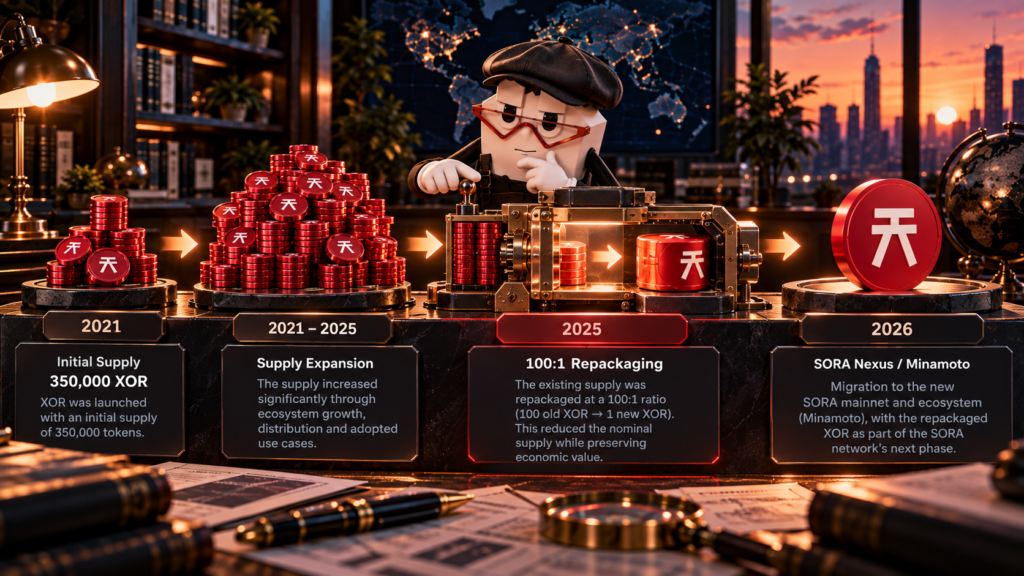
SORA v2 Started With 350,000 XOR
The SORA v2 implementation plan described a major tokenomics transition before launch, including reducing the pre-launch XOR supply from more than 1.6 billion units to 350,000 and then allowing the SORA v2 economic system to manage supply after launch.
SORA v2 subsequently launched in April 2021 with 350,000 XOR. That figure is an important historical starting point, but it is not a valid estimate of today’s circulating supply.
XOR Supply Later Expanded Dramatically
Over the following years, the nominal supply became vastly larger than the original 350,000 XOR.
The scale of that change was acknowledged by SORA itself. In an official supply update, SORA said total XOR supply had peaked at 308.5 billion on May 26 before later dropping below 300 billion.
Those figures predate the later 100:1 repackaging and therefore should not be compared directly with post-repackaging balances without adjusting for denomination.
The key point is not simply that supply increased. The number of XOR units underlying the market price changed by orders of magnitude over the token’s history.
Why XOR’s $982 High Cannot Be Compared Directly With Today’s Price
CoinGecko’s legacy SORA price series records XOR’s all-time high at $981.83 on April 6, 2021. That historical unit price is real as a recorded market observation, but it does not mean today’s XOR can be valued by simply calculating its percentage decline from $981.83.
The reason is supply.
A token trading at $1 with one million circulating units and a token trading at $1 with one billion circulating units have the same unit price but radically different market values. Conversely, changing the number of units representing the same proportional ownership can change the displayed unit price without proportionally creating or destroying economic value.
XOR experienced both substantial supply changes and a later denomination change. Its current market representation also differs from the legacy dataset containing the $981.83 high.
That break is visible in the market data. The current CoinGecko XOR listing has its own price history and records a separate all-time high of $17.08 on June 7, 2026. It also currently reports total supply while leaving circulating supply unavailable.
The legacy and current listings therefore should not be treated as one economically unchanged price series.
What the 100:1 XOR Repackaging Actually Changed
By 2025, SORA was dealing with token balances large enough that the project proposed repackaging XOR into more manageable units.
100 Old XOR Became 1 Repackaged XOR
SORA’s May 2025 ecosystem update says the successful referendum repackaged every 100 XOR into one unit. It also explains that the change applies inside the SORA network, while XOR held on other blockchains is unaffected and is converted into the new denomination when bridged into SORA.
This is economically different from simply destroying 99% of a holder’s assets. If balances and relevant accounting units are adjusted proportionally, fewer displayed units do not by themselves make an account proportionally less valuable.
SORA’s announcement channel separately confirmed that the completed migration used the formula 100 old XOR = 1 new XOR and described the change as internal to the SORA network.
CoinMarketCap’s 1,000,000:1 Notice Is a Separate Data Problem
There is an unresolved discrepancy in third-party market data.
The legacy SORA page on CoinMarketCap currently displays a notice stating that SORA underwent a 1,000,000:1 swap. The same page reports approximately 989.98 million XOR as a self-reported circulating supply and a much larger legacy total-supply figure.
That notice should not be silently equated with the documented May 2025 repackaging. SORA’s primary-source documentation for that event is explicit about a 100:1 conversion.
The public evidence reviewed for this article is insufficient to reconcile CoinMarketCap’s 1,000,000:1 label with that specific 100:1 network event. The two figures are therefore treated here as separate records rather than forced into a single explanation.
How Many XOR Actually Exist Today?
This sounds like a simple question. It is not.
“XOR supply” can refer to several different measurements: SORA v2 total supply, circulating supply, XOR represented on Ethereum or XOR already migrated into SORA Nexus.
Native XOR Is Identified by an Asset ID
XOR is fundamentally a native SORA asset rather than an ERC-20 token. SORA’s documented core Asset ID for XOR is:
0x0200000000000000000000000000000000000000000000000000000000000000SORA’s supply-checking documentation explains that network supply can be queried through assets → totalSupply(assetId). But it includes a crucial warning: the result is total supply, including locked tokens and circulating supply, rather than circulating supply alone. Its documented example also notes that Ethereum-side XOR was included in the displayed XOR total at the time.
That means mechanically multiplying a SORA totalSupply result by a market price is not a reliable way to calculate circulating market capitalization.
Ethereum XOR Is Only One Representation of XOR
In 2026, SORA announced that XOR had returned to Ethereum through the HASHI bridge. The current ERC-20 contract is:
0x1d03ebbd6be00b805702dde42313dcf44ac1a6ebThe Ethereum contract record identifies the token as XOR and attributes the deployment to a SORA-labelled deployer. Because this is an Ethereum-side representation connected to SORA’s bridge infrastructure, its contract supply should not automatically be treated as the complete economic supply of XOR across the ecosystem.
Why XOR’s Market Cap Is So Hard to Calculate
A conventional crypto market capitalization is usually calculated as market price multiplied by circulating supply. XOR’s problem is not the multiplication. It is establishing a reliable denominator.
| Source or measurement | What it shows | Why it is not automatically circulating market cap |
|---|---|---|
| Current CoinGecko listing | Price, total supply and FDV | Circulating supply is unavailable |
| Legacy CoinMarketCap listing | Legacy supply data and a self-reported circulating figure | The page also carries a 1,000,000:1 swap notice that has not been reconciled here with SORA’s documented 100:1 repackaging |
| SORA v2 totalSupply query | Network total supply | SORA documentation says the figure includes locked as well as circulating tokens |
| Ethereum ERC-20 contract | XOR represented on Ethereum | It is one cross-chain representation rather than a verified ecosystem-wide circulating supply |
| SORA Nexus Minamoto | XOR claimed after qualifying SORA v2 burns | It represents XOR migrating into the new network environment |
The problem is especially visible in CoinGecko’s current XOR historical data. Recent entries contain prices and trading volume while the market-cap column is reported as zero, consistent with the listing’s missing circulating-supply figure.
CoinGecko does publish a fully diluted valuation based on the total supply associated with its current listing. But FDV is not the same measurement as circulating market capitalization.
Nor can the Ethereum contract solve the problem by itself. Valuing the ERC-20 contract’s token supply at an Ethereum-market price would describe that representation at a particular snapshot; it would not establish a normalized circulating valuation across SORA v2, Ethereum and Nexus.
For that reason, The Crypto Public does not assign XOR a reconstructed “true market cap” by combining incompatible public supply figures. A defensible estimate would require a normalized, non-duplicative circulating-supply figure across the relevant environments.
SORA Is Still Being Developed — but the Network Is Changing
The collapse of the legacy XOR unit price does not, by itself, establish that SORA was abandoned.
On April 26, 2026, SORA announced the launch of Minamoto, describing it as the first live mainnet step for SORA Nexus. The same announcement says Taira remains the testnet environment and that XOR enters Minamoto through burn-backed claims from SORA v2.
The announcement also makes broader claims about future institutional and central-bank use. Those claims should be distinguished from independently verified production adoption: a project statement that institutions are expected to use infrastructure is not the same evidence as independently documented live deployment.
XOR Moves to Minamoto Through a Burn-Backed Claim
The migration design is unusually important for understanding supply.
The Minamoto XOR claim interface says users submit a finalized SORA v2 burn transaction and the claim service mints Nexus XOR to the recipient encoded in the transaction. The interface currently states that eligibility begins at SORA v2 block 25,867,651 and describes the mint path as “burn claim only,” with no faucet, developer top-up route or alternative Nexus XOR mint command through that system.
This burn should not be interpreted like an ordinary permanent supply-reduction event. When one representation is destroyed specifically so corresponding XOR can be created on another network, the operation is primarily a migration. Counting the burn as a reduction while ignoring the claimed Nexus XOR would understate economic supply; counting both representations simultaneously could double count it.
What Gives XOR Utility Today?
Within SORA, XOR retains documented roles in transaction fees, staking and liquidity. The transition to Nexus adds a new network environment for migrated XOR, while other projects are experimenting with additional mechanisms involving the token.
TONSwap Lets Users Burn XOR to Reserve a Future TS Claim
TONSwap currently describes its campaign with the instruction “Burn XOR. Reserve TS.” According to the project, qualifying burns use real XOR on SORA mainnet, are irreversible and reserve a future TS claim for the signing SORA wallet.
That distinction matters. The mechanism is not simply an instant XOR-to-TS swap. XOR is burned now in connection with a planned future TS claim.
TONSwap also states that its public testnet is live and that mainnet is still ahead. The campaign can therefore involve real SORA-mainnet XOR while the TONSwap DEX itself remains pre-mainnet.
TONSwap Also Proposes an XOR Buyback-and-Burn
TONSwap’s published TS tokenomics describe another potential connection to XOR. Under the stated design, protocol fees buy and burn TS; 90% of the TS burned during a daily cycle is intended to be re-minted while 10% remains permanently burned. The published distribution allocates 70% to liquidity providers, 10% to the DAO treasury and 10% to buying and burning XOR.
If implemented as described, that would connect TONSwap economic activity to market purchases and burns of XOR. But the eventual effect depends on actual mainnet usage, fee generation and execution of the published tokenomics. A planned buyback-and-burn mechanism is not evidence of material demand by itself.
Not Every Burn Has the Same Economic Meaning
Burn terminology can obscure important differences.
- A permanent campaign burn can remove XOR in connection with another economic benefit, such as a future token claim.
- A future buyback-and-burn mechanism could remove XOR purchased using protocol-generated resources if the mechanism operates as designed.
- A SORA v2-to-Minamoto burn is paired with the ability to mint corresponding Nexus XOR and is therefore primarily a migration mechanism.
There is also a separate distinction in older SORA tokenomics. SORA’s validator-reward documentation describes half of XOR transaction fees being used to buy back and burn VAL, rather than simply stating that half of every transaction fee is itself burned as XOR. That mechanism should not be conflated with a direct XOR fee burn.
Whether XOR’s economic supply is shrinking therefore depends on the net interaction between issuance, genuine permanent burns, migration and the denomination being measured. Seeing the word “burn” is not enough to establish sustained deflation.
What We Still Cannot Verify About XOR
Several important parts of XOR’s history can be verified from primary sources: SORA v2 began with 350,000 XOR; its supply model was elastic; the network implemented a 100:1 internal repackaging in May 2025; XOR returned to Ethereum through HASHI; and Minamoto now provides a burn-backed migration path into SORA Nexus.
Other questions remain unresolved from the public data reviewed for this article.
- A current, independently verified circulating XOR supply normalized across the relevant SORA v2, Ethereum and Nexus representations is not available from the major market-data sources reviewed.
- Without that figure, a conventional current circulating market capitalization cannot be established with the same confidence as for assets with verified circulating-supply data.
- CoinMarketCap’s legacy 1,000,000:1 swap notice has not been reconciled here with SORA’s primary-source documentation of the May 2025 100:1 network repackaging.
- The $981.83 historical unit-price high does not by itself establish XOR’s historical peak market capitalization. That requires reliable circulating supply for the relevant date.
- The eventual economic effect of TONSwap’s proposed XOR buyback-and-burn cannot be measured before meaningful mainnet activity and fee generation exist.
These are not minor technicalities. They determine whether price, supply and valuation figures are actually comparable.
Frequently Asked Questions About SORA and XOR
What happened to SORA XOR?
XOR went through several major economic and technical changes after SORA v2 launched in 2021. Its elastic supply expanded far beyond the original 350,000 XOR, SORA implemented a 100:1 internal repackaging in 2025, XOR returned to Ethereum through a new contract in 2026, and XOR can now migrate from SORA v2 into the SORA Nexus Minamoto mainnet through burn-backed claims.
Did XOR really reach $981.83?
Yes. The legacy XOR price series records an all-time high of $981.83 on April 6, 2021. However, that unit price should not be directly compared with the current XOR listing because supply, denomination and token representation changed substantially afterward.
How many XOR are in circulation?
A reliable current circulating-supply figure could not be established from the public sources reviewed. SORA provides a method for querying total supply, but its documentation explicitly says that total supply includes locked and circulating tokens. The current CoinGecko listing does not publish a circulating-supply figure.
What is XOR’s market cap?
A conventional circulating market capitalization cannot currently be verified from CoinGecko because its current XOR listing lacks circulating supply. CoinGecko does publish an FDV based on total supply, but FDV and circulating market capitalization are different measurements. Ethereum contract supply alone should not be used as a proxy for the entire SORA ecosystem.
Is SORA still active?
SORA continues to show verifiable network and software development activity. Minamoto launched as the SORA Nexus mainnet in April 2026, SORA v2 infrastructure remains relevant to the migration process, and XOR has returned to Ethereum through HASHI. Continued development should not, however, be interpreted as evidence about future token price or adoption.
What is SORA Nexus?
SORA Nexus is the project’s newer network architecture associated with Hyperledger Iroha 3. Minamoto is its live mainnet environment, while Taira remains the test environment described by SORA. SORA v2 XOR can enter Minamoto through the designated burn-and-claim migration process.
What is the new XOR Ethereum contract?
The current Ethereum ERC-20 XOR contract is 0x1d03ebbd6be00b805702dde42313dcf44ac1a6eb. SORA announced XOR’s return to Ethereum through its HASHI bridge in 2026.
Does burning XOR always reduce its economic supply?
No. The effect depends on why the XOR is burned. A permanent burn can remove units, while a migration burn that enables corresponding XOR to be claimed on another network primarily changes where the asset is represented. Supply analysis must account for both sides of a migration.
The Bottom Line
The central mistake when analyzing SORA is to treat XOR as though one unchanged token supply sat behind one continuous price chart from 2021 to today.
It did not.
SORA v2 began with 350,000 XOR and an elastic-supply model. The nominal supply later expanded dramatically. SORA then repackaged network balances at 100 old XOR to 1 repackaged XOR while preserving external-network compatibility. XOR subsequently returned to Ethereum through HASHI, and SORA is now moving XOR into its Nexus architecture through burn-backed claims.
Those changes explain why the old $981.83 high cannot be used as a simple benchmark for today’s XOR price and why a small Ethereum-side supply cannot establish the total circulating XOR supply.
They also expose the larger data problem. Without a reliable, normalized circulating-supply figure across the relevant SORA environments, XOR’s current circulating market capitalization cannot be reconstructed responsibly from the public numbers reviewed here.
SORA remains technically active, and mechanisms including Nexus migration and TONSwap’s proposed XOR buyback-and-burn create additional supply flows worth understanding. But development activity, token burns, migration and historical prices answer different questions. None of them, by itself, establishes XOR’s current valuation.
For XOR, understanding the denominator is just as important as watching the price.














Responses (0 )