



For much of their short history, spot Ethereum exchange-traded funds have offered traditional investors a relatively simple proposition: exposure to the price of ETH without requiring them to directly hold or manage the asset.
Staking is beginning to change that equation.
Ethereum is not only a tradable digital asset. Under its proof-of-stake model, ETH can be committed to the network to help secure transactions and, in return, generate staking rewards. For an investment product holding ETH, that creates an important question: should investors receive exposure only to the asset’s price, or also to the economic activity their ETH can generate?
That question is becoming increasingly relevant as U.S. Ethereum investment products incorporate staking more explicitly into their structures. 21Shares recently renamed its 21Shares Ethereum ETF as the 21Shares Ethereum Staking ETF, while other issuers including Grayscale have also developed staking-enabled Ethereum products.
The shift comes as demand for U.S. spot Ethereum ETFs has strengthened. Farside Investors data show approximately $1.41 billion in net inflows across nine consecutive trading days between August 17 and August 27, 2026, based on The Crypto Public’s calculation of the firm’s daily flow figures.
But staking does more than introduce another potential source of return. It also introduces validator, liquidity, operational and slashing risks that do not exist in the same way for an ETF that simply holds ETH.
The result is a potentially important evolution in the institutional Ethereum thesis: ETH exposure is beginning to encompass not just price, but participation in the economics of the network itself.
Key Findings
- Ethereum ETFs are evolving beyond pure price exposure. Staking allows eligible products to capture rewards generated by ETH committed to Ethereum’s proof-of-stake network.
- 21Shares has made staking part of the product’s identity. The 21Shares Ethereum ETF was renamed the 21Shares Ethereum Staking ETF, reflecting staking more explicitly in how the product is positioned.
- Investor demand has strengthened alongside the shift. U.S. spot Ethereum ETFs recorded approximately $1.41 billion in net inflows over nine consecutive trading days from August 17 through August 27, according to The Crypto Public’s calculation using Farside Investors data.
- Staking changes the risk profile as well as the return profile. Validator performance, liquidity constraints, operational dependencies and potential slashing become relevant considerations.
- The institutional ETH case may therefore be changing. Investors evaluating Ethereum through regulated products increasingly have to consider ETH not only as an asset whose price can appreciate or decline, but as an asset that can participate in and generate rewards from the network it helps secure.
What Changed at 21Shares?
On August 25, 2026, 21Shares filed a notice with the U.S. Securities and Exchange Commission announcing that the 21Shares Ethereum ETF would be renamed the 21Shares Ethereum Staking ETF. The name change became effective on August 27, making staking a more explicit part of the product’s identity.
The change did not represent the introduction of staking itself. The fund had already incorporated staking into its structure before the rebrand. Instead, the new name brings the staking component to the forefront, making clearer that the product is designed to provide exposure not only to ETH’s market performance but also to rewards generated from staking a portion of its holdings.
At the same time, the fund changed its pricing benchmark from the CME CF Ether-Dollar Reference Rate to the FTSE Ethereum Index. According to the filing, the fund’s ticker and CUSIP remained unchanged.
21Shares describes the fund’s objective as seeking to track the performance of ether, adjusted for the Trust’s expenses and other liabilities, while also reflecting rewards from staking a portion of its ETH. The issuer states that staking rewards vary with network conditions and are not guaranteed.
This distinction matters. A conventional spot Ethereum ETF can provide investors with exposure to changes in the price of ETH. A staking-enabled product introduces another economic component: part of the underlying ETH can participate in Ethereum’s proof-of-stake system and potentially generate additional rewards.
That makes the recent rebranding more than a cosmetic change. It highlights a broader question now emerging around institutional Ethereum products: whether simply holding ETH is enough, or whether capturing the asset’s native staking economics will increasingly become part of the investment proposition.
Why Staking Changes an Ethereum ETF
A spot Ethereum ETF gives investors exposure to ETH without requiring them to manage wallets, private keys or direct custody. But if the ETH held by the fund remains unstaked, investors are primarily exposed to one part of the asset’s economics: its market price.
Staking introduces another dimension.
Ethereum uses a proof-of-stake consensus mechanism in which validators commit ETH to help secure the network and process transactions. In return for performing those responsibilities, validators can earn rewards. Those rewards are generated through Ethereum’s protocol and network activity rather than through interest payments from a traditional borrower.
For an ETF holding ETH, this creates a meaningful distinction. If part of the fund’s ETH is staked, the underlying assets can potentially generate additional ETH over time. Depending on the structure of the product, those rewards may contribute to the value delivered to shareholders after fees, expenses and other deductions.
This means two products holding the same underlying asset can offer economically different forms of exposure. One may simply track movements in ETH’s market price, while another may combine price exposure with participation in Ethereum’s staking economy.
The difference becomes particularly important for institutional investors. When evaluating traditional assets, institutions often consider not only potential price appreciation but also whether an asset can generate cash flows, income or other forms of economic return. ETH does not fit neatly into those traditional categories, but staking introduces a network-native reward mechanism that becomes difficult to ignore when comparing different ways of gaining exposure to the asset.
However, staking rewards should not be treated as guaranteed income. Reward rates can change, operational costs can reduce what ultimately reaches investors, and staking introduces risks that a simple spot-holding structure may not face.
The important shift, therefore, is not that staking automatically makes an Ethereum ETF better. It is that investors may increasingly need to evaluate two components of ETH exposure: the market value of the asset and the economic rewards that can potentially be generated by participating in the network.
The Other Side of Staking: New Rewards, New Risks
Staking can introduce an additional source of economic return, but it also changes the risk profile of an Ethereum investment product.
The first consideration is validator risk. Staked ETH participates in Ethereum’s consensus process through validators. If validators fail to perform their duties correctly, rewards can be reduced. More serious violations of protocol rules can result in slashing, where a portion of the staked ETH may be lost.
There is also a liquidity trade-off. ETH committed to staking cannot always be treated with the same immediate flexibility as unstaked ETH. Funds must manage how much ETH is staked while maintaining sufficient liquidity to support their operational requirements and the creation and redemption processes that underpin ETF trading.
Operational complexity increases as well. A fund may depend on custodians, staking providers, validators and other infrastructure to manage the staking process. Each additional component introduces dependencies that do not exist to the same degree when an investment vehicle simply holds ETH in custody.
Staking rewards themselves are also variable rather than fixed. The amount generated can change as network conditions, validator participation, transaction activity and other protocol-level factors evolve. The headline staking yield at any particular moment should therefore not be interpreted as a guaranteed rate of return.
There are regulatory and structural considerations too. How staking is implemented, how rewards are treated, what portion of a fund’s ETH can be committed and how those rewards ultimately benefit shareholders can depend on the design of the individual product and the regulatory framework under which it operates.
For institutional investors, this creates a more complicated calculation. Staking may allow an Ethereum product to capture more of the underlying asset’s economic functionality, but doing so introduces risks and operational requirements that must be weighed against the potential rewards.
The relevant comparison is therefore not simply “staking yield versus no staking yield.” It is whether the additional rewards adequately compensate for the additional complexity and risks required to generate them.
ETF Flows Show Growing Demand for Ethereum Exposure
The evolution of staking-enabled Ethereum products is taking place against a backdrop of renewed demand for U.S. spot Ethereum ETFs.
Between August 17 and August 27, 2026, U.S. spot Ethereum ETFs recorded nine consecutive trading days of net inflows. Based on The Crypto Public’s calculation of daily flow data, those inflows totaled approximately $1.41 billion over the period.
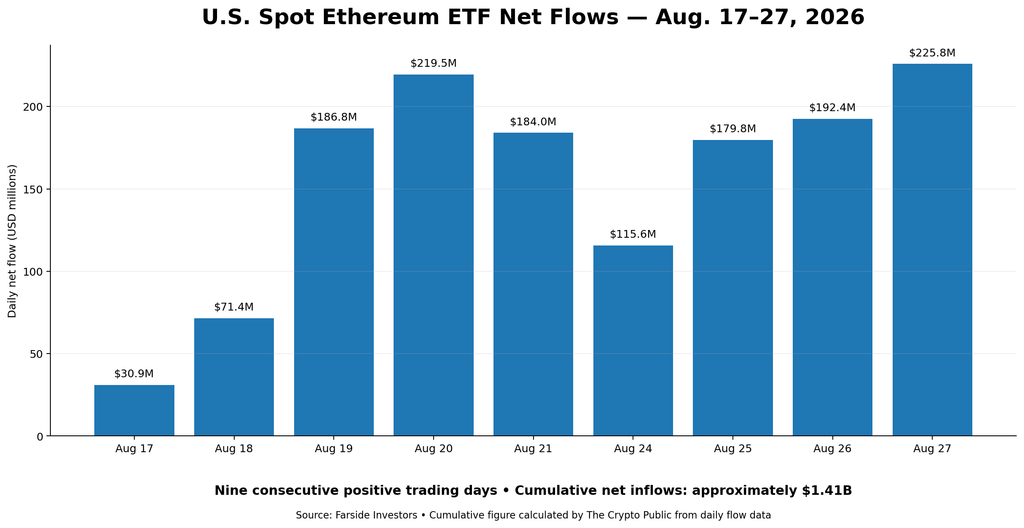
The strength of the flows is notable because it shows that institutional and traditional-market access to Ethereum is expanding at the same time that the structure of some Ethereum investment products is becoming more sophisticated.
However, the two developments should not be confused.
There is not enough evidence to conclude that staking itself caused the recent ETF inflows. Investor demand for Ethereum products can be influenced by a wide range of factors, including ETH’s market performance, broader crypto sentiment, portfolio allocation decisions and changing expectations around the asset.
The flow data instead provides important context: the debate over staking is occurring in a market where significant capital is already moving through regulated Ethereum investment vehicles.
That makes product structure increasingly relevant. As more capital enters the category, differences between funds — including fees, liquidity, custody arrangements, benchmarks and the ability to capture staking rewards — may become more important when investors compare Ethereum products.
For issuers, staking could therefore become more than a technical feature. It may develop into a point of differentiation between products that otherwise provide exposure to the same underlying asset.
For investors, the question becomes more nuanced: if two regulated products both hold ETH, but only one captures part of Ethereum’s native staking rewards, how should the economic difference between those products be valued?
Why Staking Matters for the Institutional ETH Case
Institutional investors have often approached crypto assets through frameworks borrowed from traditional finance. Bitcoin, for example, is frequently evaluated through scarcity, liquidity and price exposure. Ethereum is more difficult to fit into the same framework because ETH also plays an active role in operating and securing its network.
Staking makes that distinction harder to overlook.
ETH is required by validators participating in Ethereum’s proof-of-stake consensus system. When ETH is staked, it becomes part of the infrastructure used to secure the network, with validators receiving protocol-generated rewards for performing their responsibilities.
For an institutional investor, this means ETH can potentially be evaluated through more than changes in its market price. The asset also has a network function capable of producing additional ETH when deployed through staking.
That does not make ETH equivalent to a bond, dividend-paying stock or other traditional income-producing asset. Staking rewards arise from a fundamentally different mechanism, and applying conventional valuation frameworks too directly can obscure important differences in risk and structure.
But the existence of those rewards still matters when institutions compare ways of gaining Ethereum exposure.
An investment product that holds ETH without staking does not participate in the staking rewards available through Ethereum’s proof-of-stake system. A staking-enabled product can potentially capture part of it, although fees, operational costs, product structure and staking risks determine how much of that value ultimately reaches shareholders.
This could gradually change competition within the Ethereum ETF market. If staking becomes more widely available, investors may begin comparing products not only by management fees, trading liquidity and tracking performance, but also by how efficiently they participate in Ethereum’s staking economy.
The development could also influence how ETH itself is discussed within institutional portfolios. Rather than being viewed exclusively as a volatile digital asset whose investment case depends on future price appreciation, ETH may increasingly be evaluated as an asset that combines market exposure with a functional role inside a blockchain network.
That distinction is central to the emerging institutional Ethereum case.
Staking does not remove ETH’s price risk. It adds another economic dimension to the asset — and another set of variables investors must understand.
This Is Bigger Than 21Shares
21Shares is not the only asset manager exploring how staking can be incorporated into regulated Ethereum investment products.
Grayscale has also moved staking into the structure of its Ethereum offerings, demonstrating that the concept is becoming part of a broader discussion about what regulated ETH exposure should actually include.
In an April 2026 fact sheet filed with the SEC, Grayscale reported that approximately 71% of ETHE’s ETH holdings were staked at the time. The figure illustrates how staking can become a material part of an Ethereum investment product rather than a peripheral feature.
That matters because the first generation of U.S. spot Ethereum ETFs largely solved an access problem. Investors could gain exposure to ETH through familiar brokerage and investment infrastructure without directly managing wallets, private keys or on-chain transactions.
The next stage of competition may be about what that exposure contains.
If staking becomes increasingly integrated into regulated Ethereum products, issuers will have to make decisions about how much ETH is staked, which infrastructure providers are used, how liquidity is maintained, how rewards are distributed or reflected in fund value, and how staking-related risks are managed.
Those differences could make Ethereum ETFs less interchangeable than they initially appear.
Two funds may both provide exposure to ETH while producing different outcomes because of their fees, tracking methods, liquidity and staking strategies. Investors comparing Ethereum products may therefore need to look beyond the ticker and headline expense ratio to understand how the underlying ETH is actually being used.
There is also a competitive dimension for issuers. If investors begin to place meaningful value on staking rewards, products that leave all of their ETH unstaked could face pressure to explain why they are foregoing an economic feature available directly through the Ethereum network.
But that outcome is not guaranteed.
Some investors may prefer the simplicity of a product that minimizes staking-related operational and liquidity risks. Regulatory requirements may also constrain how aggressively individual funds can use staking. Different products could therefore emerge for different investor preferences rather than converging on a single model.
The broader development is nevertheless significant: regulated Ethereum exposure is beginning to move from the question of whether institutions can hold ETH toward the question of how that ETH should be used once they hold it.
What This Means for Ethereum
The integration of staking into regulated investment products does not change Ethereum’s underlying technology, but it may change how traditional investors interact with the asset.
The first wave of spot Ethereum ETFs made ETH easier to access through conventional financial infrastructure. Investors could gain exposure without directly managing wallets, custody or on-chain transactions. Staking-enabled products extend that model by attempting to capture another feature of ETH: its ability to participate in securing the Ethereum network and generate protocol-level rewards.
That could make the structure of Ethereum investment products increasingly important.
If staking becomes a standard feature across more regulated products, competition between issuers may move beyond management fees and trading liquidity. How much ETH is staked, how rewards are handled, which providers operate the staking infrastructure and how liquidity and slashing risks are managed could all become meaningful differences between funds.
There could also be implications for Ethereum itself. Larger amounts of institutionally held ETH participating in staking could connect regulated financial products more directly with Ethereum’s validator economy. At the same time, that development would raise additional questions about concentration, infrastructure providers and how institutional staking activity affects the distribution of validators across the network.
None of this means staking guarantees superior investment outcomes. ETH remains exposed to substantial market volatility, staking rewards fluctuate, and the additional operational structure introduces risks that investors do not face in exactly the same way with simple spot exposure.
What is changing is the nature of the question institutions are being asked to consider.
The original ETF debate was largely about access: can investors obtain regulated exposure to ETH without holding the asset directly?
The emerging debate is increasingly about participation: once an investment product holds ETH, should that ETH remain passive, or should it participate in the economic system that Ethereum was designed around?
For Ethereum, that distinction could become increasingly important as regulated crypto products mature.
The next generation of Ethereum ETFs may therefore be defined not simply by how much ETH they hold, but by what they do with it.
Sources & Methodology
This article is based primarily on regulatory filings and product disclosures from the U.S. Securities and Exchange Commission and 21Shares, including documentation related to the 21Shares Ethereum Staking ETF and its staking structure.
The Crypto Public also reviewed official Ethereum documentation to verify how proof-of-stake, validator rewards, penalties and slashing operate at the protocol level. Grayscale regulatory filings were used to provide additional context on the integration of staking into regulated Ethereum investment products.
U.S. spot Ethereum ETF flow data was sourced from Farside Investors. The approximately $1.41 billion cumulative net inflow figure for August 17–27, 2026 was calculated by The Crypto Public from the daily figures reported by Farside.
The analysis distinguishes between documented product developments and conclusions drawn by The Crypto Public. Recent ETF inflows and the expansion of staking-enabled products are presented as concurrent developments; the article does not assume that staking caused those inflows.
- U.S. Securities and Exchange Commission — 21Shares Ethereum Staking ETF filing (August 2026)
SEC — 21Shares Ethereum Staking ETF filing - 21Shares — 21Shares Ethereum Staking ETF (TETH)
21Shares — Official TETH product page - Ethereum.org — Proof-of-Stake
Ethereum.org — Proof-of-Stake documentation - Ethereum.org — Proof-of-Stake Rewards and Penalties
Ethereum.org — Rewards and Penalties documentation - U.S. Securities and Exchange Commission — Grayscale Ethereum Staking ETF fact sheet (April 2026)
SEC — Grayscale Ethereum Staking ETF fact sheet - Farside Investors — U.S. Ethereum ETF Flow Data
Farside Investors — Ethereum ETF flow data















Responses (0 )