

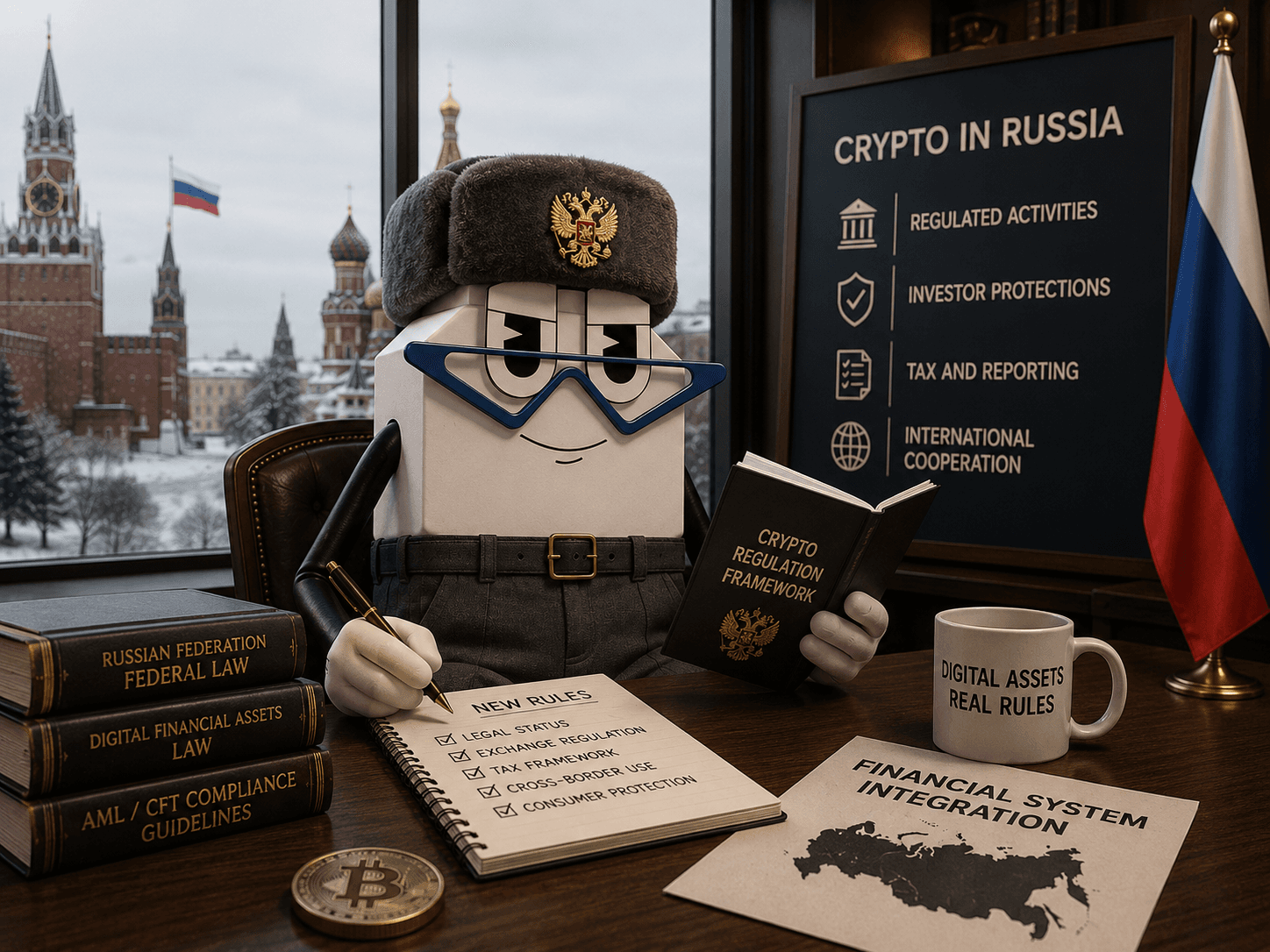

Russia’s new cryptocurrency framework takes effect on September 1, opening regulated crypto trading to a far broader investor base while placing Bitcoin, Ethereum and USDT inside a tightly controlled financial structure. On the same day, the country begins a major expansion of its digital ruble infrastructure. Together, the changes reveal something bigger than a new crypto market: Russia is attempting to bring digital assets into its formal financial system without surrendering control over how they are accessed, held or used.
September 1, 2026 is shaping up to be one of the most consequential dates yet for Russia’s digital asset market.
A new regulatory framework is taking effect that allows both qualified and non-qualified investors to buy cryptocurrencies through regulated intermediaries. At the same time, Russia’s largest banks and major retailers are beginning a broader rollout of the digital ruble.
These developments involve very different forms of digital money.
Bitcoin, Ethereum and stablecoins operate on public blockchain networks outside the direct monetary control of a central bank. The digital ruble, by contrast, is a liability of the Bank of Russia and forms a new version of sovereign money.
Yet Russia is expanding access to both at nearly the same moment.
That makes the story bigger than the headline figure attracting attention across crypto markets: Sberbank’s projection that regulated cryptocurrency exchange trading could reach roughly 4 trillion rubles — about $46 billion at recent exchange rates — during the first year of the new regime.
The more important question is what Russia is actually building.
The answer appears to be neither a blanket embrace of cryptocurrency nor an attempt to eliminate it.
Instead, Russia is bringing crypto into a regulated financial architecture built around licensed intermediaries, investor restrictions, reporting requirements and formal custody infrastructure — while simultaneously expanding a state-operated digital currency.
Key Findings
- Russia’s new crypto framework takes effect on September 1, 2026, expanding regulated access to digital assets while keeping cryptocurrency payments prohibited inside the country.
- Non-qualified investors can purchase eligible cryptocurrencies after passing a risk-awareness test, subject to a 300,000-ruble annual limit through each intermediary.
- Bitcoin, Ethereum and Tether’s USDT are the first crypto assets identified by the Bank of Russia as meeting its criteria for broader public exchange trading.
- Sberbank estimates that regulated cryptocurrency trading could reach up to 4 trillion rubles — roughly $46 billion — in the market’s first year, but the figure is a forecast rather than guaranteed trading volume.
- Sberbank is also exploring a larger role for crypto inside traditional finance, including the use of Bitcoin, Ethereum and USDT as collateral, subject to regulatory approval.
- Russia is expanding the digital ruble at the same time, creating two distinct tracks: regulated crypto assets within the financial system and a central bank-issued digital currency for sovereign digital payments.
- The framework does not amount to unrestricted crypto adoption. Russia is expanding access while simultaneously increasing licensing, reporting, custody and regulatory oversight.
What Changes on September 1?
The new framework fundamentally changes how cryptocurrency can be accessed inside Russia.
According to the Bank of Russia, both qualified and non-qualified investors will be able to conduct cryptocurrency transactions through intermediaries.
For non-qualified investors, access comes with significant restrictions.
They must first pass a test designed to assess their understanding of crypto-related risks. They may then purchase only cryptocurrencies that meet regulatory eligibility criteria, with purchases capped at 300,000 rubles per year through each intermediary.
Qualified investors must also complete risk testing, but they may purchase and sell a much broader range of cryptocurrencies without the same monetary limit.
The framework is also creating an institutional layer around crypto.
Existing financial institutions can participate alongside newly regulated entities such as cryptocurrency exchanges and digital repositories. Brokers and asset managers can also facilitate transactions, including through organized trading venues.
That distinction matters.
Russia is not simply telling residents that cryptocurrency ownership is legal. It is constructing regulated rails through which crypto activity can increasingly move.
And the Bank of Russia has already identified the assets that initially meet its criteria for public trading.
They are:
- Bitcoin
- Ethereum
- Tether’s USDT
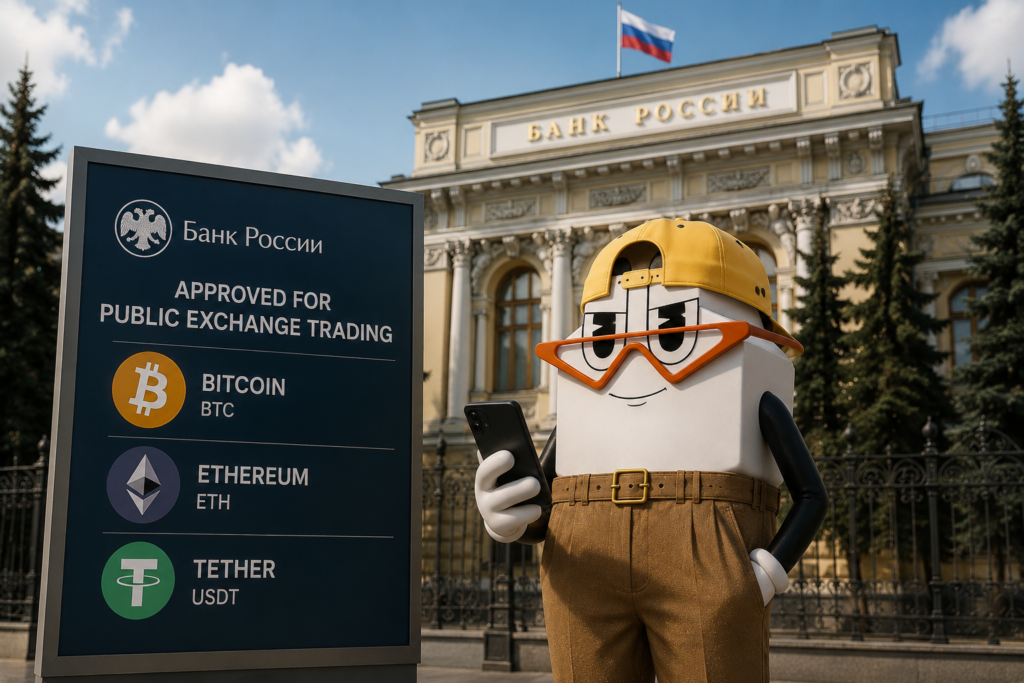
The regulator says eligible assets are assessed using factors including market capitalization, average daily trading volume and at least five years of foreign-market pricing history.
For the moment, only those three assets meet the criteria for unrestricted public circulation under the proposed rules for non-qualified investors.
That creates an unusual combination: two decentralized cryptoassets and the world’s dominant U.S. dollar-linked stablecoin at the center of Russia’s newly regulated retail crypto market.
This Is Regulation — Not Crypto Legal Tender
One distinction is essential.
Russia is not turning Bitcoin, Ethereum or USDT into domestic payment currencies.
The use of cryptocurrency to pay for goods and services inside Russia remains prohibited.
That separates the Russian model from jurisdictions that have experimented with treating Bitcoin or other cryptoassets as direct payment instruments.
Inside Russia, crypto is being treated primarily as a financial asset.
But outside Russia’s borders, the rules are different.
The Bank of Russia says exporters and importers will be permitted to use cryptocurrencies for cross-border payments, including transactions conducted directly through crypto wallets.
That gives crypto two very different roles inside the same regulatory framework.
Domestically, it can function as a regulated investment asset.
Internationally, it can also function as a settlement instrument for foreign trade.
This dual structure may prove more important over time than the opening of retail crypto trading itself.
Why Sberbank Thinks the Market Could Reach $46 Billion
Russia’s largest bank is already attempting to quantify the opportunity.
Sberbank Deputy Chairman Anatoly Popov has estimated that cryptocurrency trading on regulated Russian exchanges could reach up to roughly 4 trillion rubles in the first year of the new framework.
By 2029, Sberbank expects the figure could rise toward approximately 7.5 trillion rubles, equivalent to roughly $87 billion at recent exchange rates.
Those numbers require context.
They should not be interpreted as $46 billion of entirely new money suddenly entering cryptocurrencies.
Russia already has substantial crypto activity occurring outside the regulated exchange system.
Sber’s forecast therefore partly reflects an expectation that some existing activity will migrate from offshore platforms, informal exchange services and other channels into licensed domestic infrastructure.
This distinction matters because regulated trading volume and new investment demand are not the same thing.
A trader moving existing Bitcoin activity from an offshore venue to a licensed Russian exchange may increase regulated market volume without creating an equivalent amount of new demand for Bitcoin.
The first year of the new regime should therefore be judged not only by headline trading volume, but by how much existing crypto activity successfully migrates into the regulated system.
There is another reason the transition could take time.
Market participants have been given a transition period to obtain the required licenses and bring their operations into compliance. The new crypto market will not become fully mature on September 1.
What begins today is the infrastructure transition.
Sberbank Wants to Go Beyond Trading
Sberbank’s ambitions provide another clue about where the market could be heading.
The bank says it plans to expand crypto-backed lending after receiving the necessary regulatory approvals.
Bitcoin is already part of that experiment.
Sber previously conducted a pilot involving a loan secured by Bitcoin.
Now the bank says it eventually wants to accept not only Bitcoin but also Ethereum and USDT as collateral, once the relevant assets are permitted within the required regulatory framework.
That is potentially more significant than another crypto trading product.
When a bank allows clients to trade an asset, crypto enters the brokerage layer.
When a bank holds it in custody, crypto enters the custody layer.
When a bank begins extending credit against it, the asset starts interacting directly with the lending system.
That does not make crypto equivalent to conventional bank collateral. Important questions remain unanswered, including loan-to-value ratios, collateral haircuts, liquidation procedures, interest rates and the precise launch timeline.
But the direction is important.
The Russian crypto story may eventually be less about retail speculation and more about how digital assets become connected to traditional balance sheets.
Why Bitcoin, Ethereum and USDT?
The three assets at the center of the framework represent very different economic functions.
Bitcoin is the largest decentralized cryptoasset and the most established cryptocurrency by market history and liquidity.
Ethereum is both a monetary asset and the native asset of a programmable blockchain economy supporting stablecoins, decentralized finance, tokenization and other applications.
USDT is fundamentally different from both.
Its purpose is to track the value of the U.S. dollar.
The inclusion of USDT is particularly notable because Russia is simultaneously attempting to expand its own sovereign digital currency infrastructure.
That means Russia’s developing digital-asset landscape may contain three distinct monetary layers:
sovereign digital money, commercial bank money and public blockchain assets.
The digital ruble represents central-bank money.
Traditional bank deposits remain commercial-bank liabilities.
Bitcoin, Ethereum and USDT sit outside both structures but are increasingly being connected to them through regulation.
This is not necessarily a contradiction.
It may instead demonstrate how governments are beginning to separate the question of monetary sovereignty from the question of cryptoasset access.
A government can reject private cryptocurrency as domestic legal tender while still allowing investors, businesses and financial institutions to use crypto within defined boundaries.
The Digital Ruble Is the Other Half of the Story
The timing makes the Russian case particularly interesting.
September 1 is not only the start of the new crypto framework.
It also marks a major stage in the rollout of the digital ruble.
Russia’s largest banks are required to begin providing customers with infrastructure that allows them to use digital rubles, while major merchants above specified revenue thresholds are beginning to support digital-ruble payments.
Individuals can choose whether to open a digital-ruble account. The Bank of Russia has emphasized that accounts are not opened automatically and that use of the new currency remains voluntary for individuals.
The digital ruble is not a cryptocurrency.
It is a new form of the Russian national currency issued through infrastructure operated by the central bank.
This produces a fascinating policy contrast.
On one side, Russia is allowing broader access to decentralized digital assets.
On the other, it is extending a centrally operated digital currency.
Rather than choosing between central bank digital currency and cryptocurrency, Russia appears to be developing regulated infrastructure for both.
The two systems serve different purposes.
The digital ruble is designed as sovereign money and a payment mechanism.
Cryptocurrency remains an investment asset domestically and can serve additional functions in cross-border transactions.
This suggests that the future competition between central bank digital currencies and crypto may not always be a zero-sum contest.
Governments may instead attempt to absorb useful parts of the crypto economy while preserving central-bank control over domestic money.
Two ₽300,000 Limits — But They Are Not the Same Rule
There is an important detail that could easily create confusion.
Both Russia’s cryptocurrency framework and its digital-ruble system contain figures involving 300,000 rubles.
But they apply to completely different things.
For cryptocurrency, the relevant rule limits non-qualified investors to purchasing eligible cryptoassets worth no more than 300,000 rubles per year through one intermediary.
Separately, the Bank of Russia has established a 300,000-ruble monthly maximum for certain transfers used by individuals to increase the balance of their digital-ruble accounts from bank accounts or electronic money.
One is an investor-protection limit for crypto purchases.
The other concerns funding a digital-ruble balance.
Conflating the two would significantly misrepresent the regulatory framework.
This distinction also illustrates how complex Russia’s emerging digital-money architecture is becoming.
Cross-Border Payments Change the Strategic Context
Russia’s decision to permit cryptocurrency in foreign-trade settlements gives the framework an international dimension.
Traditional cross-border payments depend heavily on banks, correspondent relationships, clearing infrastructure and access to foreign currencies.
Russia has faced significant restrictions across portions of this system as a result of international sanctions associated with the war in Ukraine.
That context makes alternative settlement infrastructure economically relevant.
It would be an oversimplification, however, to conclude that cryptocurrency provides an unrestricted way around financial sanctions.
Public blockchains are traceable.
Centralized exchanges operate compliance programs.
Stablecoin issuers may be able to restrict certain addresses.
Foreign counterparties remain subject to their own domestic laws and sanctions requirements.
Liquidity, conversion, custody and counterparty risk also remain constraints.
Recent Western sanctions have increasingly focused on crypto-related financial infrastructure associated with Russian transactions, illustrating that digital assets do not exist outside geopolitical enforcement.
The more defensible conclusion is narrower:
crypto can provide an additional cross-border settlement rail, but it does not make the international financial system irrelevant.
More Crypto Access Also Means More State Oversight
That distinction is essential.
The most interesting feature of the Russian framework may be its apparent contradiction.
Access to cryptocurrency is expanding.
Permissionless access is not.
The new system is built around:
licensed intermediaries,
investor testing,
purchase limits,
regulated exchanges,
formal repositories,
reporting requirements,
and government-defined eligibility standards.
Russian residents may still interact with crypto internationally under defined conditions, but the state is clearly attempting to pull domestic activity toward a regulated perimeter.
This is a broader trend in crypto policy.
Early debates often treated regulation as a binary choice.
Governments would either ban cryptocurrency or allow it.
That distinction is becoming less useful.
The emerging model is increasingly:
allow crypto, define the gateways, regulate the intermediaries and monitor the flows.
Russia is now becoming a particularly visible example of that approach.
The $46 Billion Number Is Not the Biggest Story
It is easy to understand why Sberbank’s forecast attracted attention.
A potential $46 billion regulated market creates a simple headline.
But the headline may obscure the structural shift beneath it.
Russia is creating a framework in which:
Bitcoin, Ethereum and USDT can move into regulated retail investment channels;
qualified investors can access a wider crypto market;
banks can potentially provide crypto custody and collateralized lending;
crypto can continue playing a role in international trade;
new licensed crypto exchanges and repositories can connect digital assets to the existing financial sector;
and a central-bank digital currency is being expanded at the same time.
The important question is therefore not whether Russia has “embraced crypto.”
It has not, at least not in the permissionless sense associated with cryptocurrency’s origins.
The more accurate description is that Russia is attempting to institutionalize crypto without giving up control over the financial gateways around it.
What Happens Next?
Several indicators will show whether the new model is working.
The first is how much crypto activity actually migrates onto regulated Russian venues.
If Sberbank’s forecasts are approached primarily through the transfer of existing offshore activity, the reform will represent a major regulatory migration but not necessarily an equally large increase in crypto demand.
The second is participation by major financial institutions.
Trading products matter, but custody, lending and collateral services would signal deeper integration between cryptoassets and Russia’s banking sector.
The third is USDT.
A dollar-denominated stablecoin occupying a central role inside a Russian regulated crypto market creates monetary, regulatory and geopolitical questions that deserve continued attention.
The fourth is cross-border settlement activity.
If corporations increasingly use digital assets for legitimate foreign-trade transactions, crypto’s economic role in Russia could become far more important than domestic retail trading volumes suggest.
Finally, the digital ruble will provide a parallel experiment.
Russia is now testing two very different ideas at once: a sovereign digital currency built around central-bank infrastructure and a regulated market for cryptoassets built on public blockchain networks.
How those systems coexist may offer lessons well beyond Russia.
The Bigger Picture
Russia’s September 1 reforms fit into a larger shift taking place across global finance.
The question facing governments is increasingly no longer whether cryptocurrency can simply be prohibited.
Crypto markets, stablecoins and public blockchain networks have become too economically significant for that question alone to define policy.
The more relevant challenge is how these assets interact with banks, capital markets, payments and sovereign currencies.
Different jurisdictions are arriving at different answers.
Some are integrating crypto through exchange-traded investment products.
Others are creating comprehensive licensing regimes.
Some are exploring tokenized deposits, stablecoins and central bank digital currencies.
Russia is building another model: a tightly regulated domestic crypto market connected to banks and professional intermediaries, combined with a sovereign digital currency and an explicit role for crypto in international trade.
Whether that model succeeds remains uncertain.
But September 1 marks the point when it begins to move from policy design into financial infrastructure.
And that makes Russia’s crypto transition much bigger than a $46 billion trading forecast.
Sources & Methodology
This analysis is based primarily on official publications from the Bank of Russia and the Russian Government, supplemented by statements from Sberbank reported by TASS and independent reporting covering the implementation of the new framework.
Key regulatory details — including the September 1 effective date, investor classifications, the 300,000-ruble annual crypto purchase limit, the initial eligibility of Bitcoin, Ethereum and USDT, restrictions on domestic cryptocurrency payments and provisions for cross-border settlements — were checked against Bank of Russia publications.
Digital-ruble implementation dates and transaction rules were separately checked against Bank of Russia decisions and guidance to avoid conflating digital-ruble restrictions with cryptocurrency investment limits.
Sberbank’s trading-volume forecasts and plans involving crypto-backed lending are forward-looking estimates and corporate plans rather than guaranteed outcomes. Where conclusions go beyond established facts, they are presented as analysis rather than confirmed regulatory intent.
Primary Sources & Data
- Bank of Russia — Cryptocurrency Regulation: Official framework covering investor access, regulated intermediaries, cryptocurrency exchanges, digital repositories, cross-border settlements and restrictions on domestic crypto payments.
- Bank of Russia — Rules for Non-Qualified Investors: Official criteria governing retail access to cryptocurrencies, including the 300,000-ruble annual limit and the eligibility of Bitcoin, Ethereum and USDT.
- Bank of Russia — Digital Ruble Rollout: Official implementation schedule for the expansion of digital ruble infrastructure beginning September 1, 2026.
- Bank of Russia — Digital Ruble Transaction Limits: Official decision establishing the applicable 300,000-ruble monthly limit for certain individual digital-ruble funding operations.
- Sberbank / SberCIB via TASS: Forecasts for regulated cryptocurrency trading volumes in Russia, including estimates of up to 4 trillion rubles in the first year and approximately 7.5 trillion rubles by 2029.
- Reuters: Reporting used for international sanctions and crypto-infrastructure context.





















Responses (0 )