

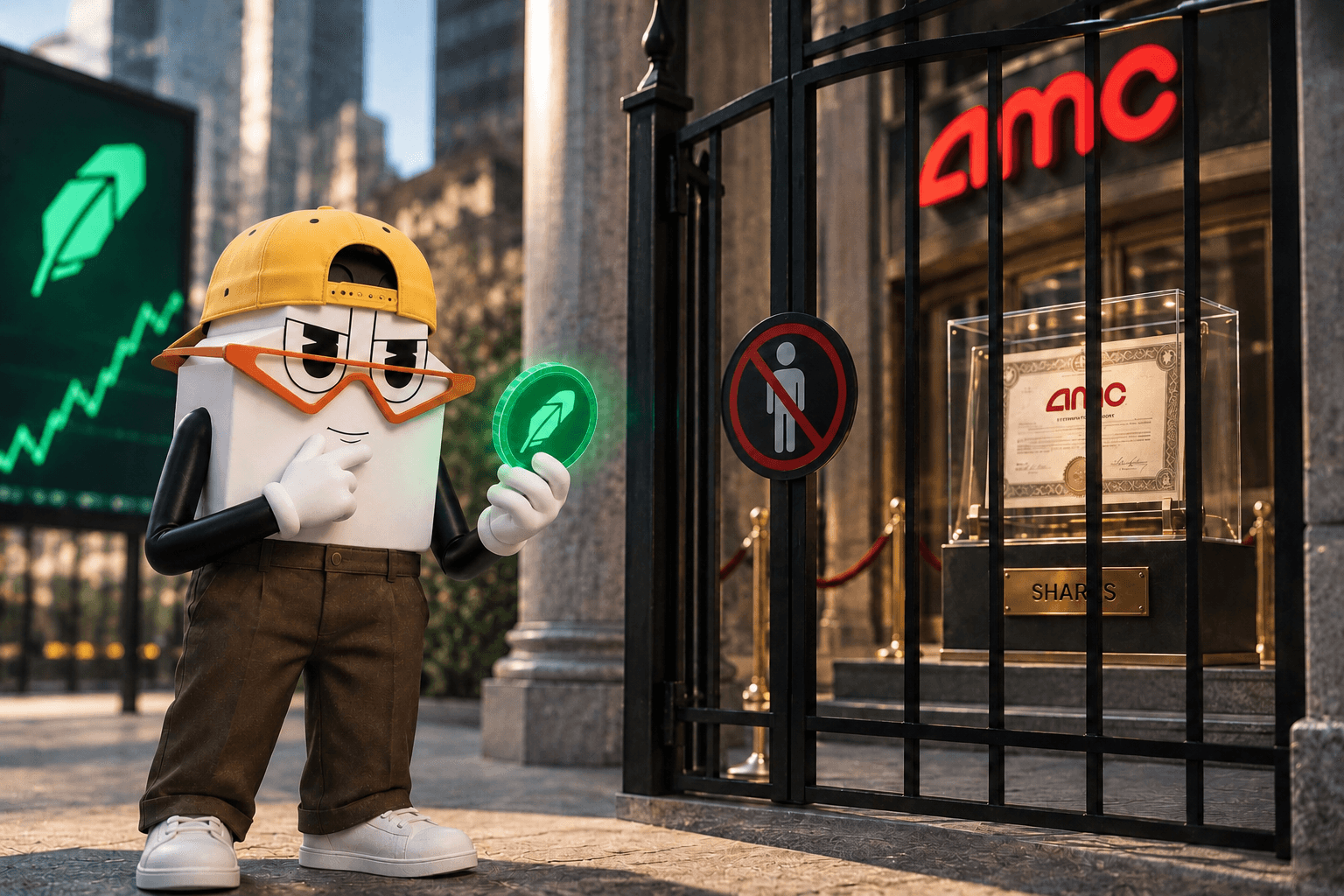

AMC Entertainment CEO Adam Aron’s objection to a Robinhood token carrying the theater chain’s name has opened a much larger debate about what it means to put a stock onchain.
The product is designed to track the economic performance of AMC shares. It is backed by conventional shares, can move across blockchain-based markets and uses AMC as its reference asset.
But it is not an AMC share.
Its holder does not become an AMC shareholder, receive direct ownership of the underlying stock or acquire a legal claim against AMC Entertainment.
That distinction is at the center of Aron’s criticism — and it illustrates why the rapidly expanding category of “stock tokens” cannot be understood from the name alone.
Robinhood’s own legal documents classify the new products as tokenised debt securities issued by Robinhood Assets (Jersey) Limited, a separate entity within Robinhood’s product structure.
The tokens provide economic exposure to the referenced securities, but they do not grant legal or beneficial rights in or against the companies whose shares they track.
The dispute is therefore about more than whether AMC approved a financial product bearing its name.
It is about the separation of market exposure from corporate ownership — and whether investors clearly understand the difference.
Latest Update — September 11, 2026
Robinhood CEO Vlad Tenev expanded his defense of stock tokens on September 11, arguing that public companies should control the rights and obligations attached to the shares they issue but should not automatically have veto power over separate financial instruments that reference those shares. The statement directly answered AMC CEO Adam Aron’s demand that Robinhood stop offering its AMC-linked product, according to CoinDesk.
Tenev’s proposed boundary is structural. He said an issuer should be involved when a token changes the rights attached to the underlying shares, replaces the company’s authoritative shareholder register or creates new obligations for the company or its transfer agent. However, he argued that issuer consent should not automatically be required when a separate financial instrument merely holds or references freely transferable shares without changing those rights, obligations or official records.
This is Tenev’s interpretation of how issuer consent should work, not a court ruling, statutory conclusion or SEC determination. AMC has said it may raise the dispute with the U.S. Securities and Exchange Commission, but that statement does not mean the SEC has opened an investigation, initiated an enforcement action or reached a finding on Robinhood’s product.
The disagreement has therefore moved beyond the question of what a token holder owns. It now concerns whether a public company should have authority over third-party onchain products that use its shares as collateral or a reference asset while leaving the company’s official shareholder register unchanged. The answer could shape how tokenized-equity platforms distinguish issuer-backed shares from separate stock-linked instruments.
Key Findings
- AMC Entertainment says it has no connection to Robinhood’s AMC-linked Stock Token and did not authorize or endorse the product.
- The token is not an AMC share. It is a tokenised debt security issued by Robinhood Assets (Jersey) Limited and linked economically to AMC stock.
- Robinhood says every Stock Token in circulation is backed 1:1 by the corresponding underlying equity, with those shares held by a U.S.-based custody partner.
- That backing does not make the token holder an AMC shareholder or provide direct legal or beneficial ownership of the underlying AMC shares.
- The investor’s claim runs through the token issuer and its contractual structure rather than directly to AMC Entertainment.
- Robinhood’s new Stock Tokens should not be confused with its Classic Stock Tokens, which are separate derivative contracts offered through Robinhood Europe.
- The dispute demonstrates how the term “tokenized stock” can describe instruments with similar price exposure but materially different ownership rights, issuers and risk structures.
What Happened?
AMC CEO Adam Aron publicly objected on September 3 after learning that Robinhood was offering a Stock Token linked to AMC Entertainment.
Aron said AMC had no connection to the initiative and did not approve it. He described the practice in strongly critical terms and said the company would ask outside securities counsel to examine the matter.
Robinhood CEO Vlad Tenev responded publicly by asking Aron to explain his concern, but the initial exchange did not resolve the larger disagreement over the product’s structure or its use of AMC as the referenced company.
The controversy arrived as Robinhood was making tokenization a central part of its international expansion.
The company has introduced tokens linked to a growing range of publicly traded stocks and exchange-traded products while developing Robinhood Chain as blockchain infrastructure for tokenized financial assets.
That strategy promises broader market access, near-continuous trading and the ability to use traditional market exposure across onchain applications.
But AMC’s objection reveals a more difficult question beneath those benefits.
Can a financial platform put the economic performance of a company’s shares onchain without putting the shares themselves onchain?
In Robinhood’s case, the answer is yes.
The AMC Token Is Not Issued by AMC
The first important distinction concerns the issuer.
AMC Entertainment Holdings issues AMC shares. Those shares represent an ownership interest in the company and exist within the legal and market infrastructure governing AMC’s publicly traded equity.
The AMC-linked Stock Token is issued by a different company:
Robinhood Assets (Jersey) Limited, or RHJ.
Robinhood’s official issuer information identifies RHJ as a private limited company incorporated in Jersey. Robinhood’s disclosure library also contains specific final terms for tokenised debt securities linked to AMC Entertainment Holdings.
This means AMC is the referenced company, but not the issuer of the token.
The distinction is comparable to the difference between an asset and a financial instrument built around that asset. A product can derive its economic value from AMC shares without being created, administered or endorsed by AMC itself.
That is why the company name on a token does not answer the ownership question.
What Does the Investor Actually Own?
Robinhood describes its new Stock Tokens as tokenised debt securities.
They provide economic exposure to underlying securities but do not give investors legal or beneficial rights in, or against, the issuer of those underlying securities.
For the AMC-linked product, that creates two separate instruments:
- The conventional AMC share issued by AMC Entertainment Holdings.
- The Stock Token issued by Robinhood Assets (Jersey) Limited and linked to the economic performance of that share.
The token holder owns the Robinhood-issued instrument.
The holder does not directly own the AMC share used within the product’s backing structure.
This means the investor’s legal claim is primarily against the token issuer under the applicable product documents. It is not a direct ownership claim against AMC.
The blockchain can establish who controls or owns a particular token.
It does not automatically establish that the same person appears as the legal or beneficial owner of the corresponding AMC share.

One AMC Share and One AMC Stock Token Are Not the Same Claim
A conventional share and a stock-linked token can respond to the same market price while representing different legal claims.
A direct AMC shareholder participates in the corporate and securities-law framework attached to AMC’s common stock. Depending on the share class and applicable rules, that can include voting rights, corporate communications and other rights arising from ownership.
A Robinhood Stock Token holder receives the rights set out in the token’s own legal documents.
Those rights are designed to reproduce economic exposure to AMC stock, but they do not turn the holder into an AMC shareholder.
The difference can be summarized through three questions:
- Who issued the instrument? AMC issued the share; RHJ issued the token.
- Who owes obligations to the investor? The token holder relies on the token issuer and the product’s contractual structure.
- Where is ownership recorded? AMC share ownership and Robinhood Stock Token ownership are recorded through different systems.
Matching price exposure does not make those legal relationships interchangeable.
The Token Is Backed 1:1 — But Ownership Still Matters
Robinhood says each Stock Token in circulation is backed 1:1 by the corresponding underlying equity.
That is an important part of the structure.
It means the AMC-linked token is not described by Robinhood as an entirely unbacked wager on AMC’s price. The company says an equivalent quantity of underlying shares is held with a U.S.-based custody partner.
But backing and ownership answer different questions.
Backing addresses how the issuer supports the economic exposure created by the token.
Ownership determines who has the legal or beneficial claim to the underlying share.
A token can therefore be fully backed by conventional shares while its holder remains legally separate from those shares.
This is one of the most important distinctions in tokenized finance.
The phrase “backed by stocks” may sound similar to “owning stocks,” but the two claims are not equivalent.
The first describes an asset-support mechanism.
The second describes a legal property relationship.
Investors need both pieces of information.
Who Holds the Underlying AMC Shares?
Robinhood’s service-provider disclosures show that the product depends on several institutions rather than a single blockchain relationship.
The disclosed structure includes:
- Robinhood Assets (Jersey) Limited as the issuer and tokenizer.
- Alpaca Securities LLC as broker and custodian.
- Bitstamp Global Ltd as the authorised participant.
- JPMorgan Chase Bank, London Branch as the paying-account provider.
- Security Agent Services AG as security agent and verification agent.
This structure provides an important counterpoint to the idea that tokenization simply removes intermediaries.
Blockchain can change how an instrument is issued, transferred and integrated into digital markets. It does not necessarily eliminate the institutional chain supporting the instrument.
In this case, the token depends on an issuer, broker, custodian, authorised participant, payment provider and security agent, in addition to the blockchain ledger itself.
Tokenization has not removed the ownership chain.
It has reorganized it.
How Dividends and Corporate Actions Work
Dividends provide another example of the difference between owning an AMC share and holding a token linked to it.
Robinhood says Stock Token holders do not receive conventional cash-dividend distributions directly.
Instead, its system uses a multiplier mechanism.
If the underlying company pays a dividend, the proceeds are used to acquire additional shares. The multiplier attached to the token then increases, allowing the token to represent a larger quantity of economic exposure over time.
This mechanism can preserve the economic effect of a dividend without giving the token holder the same direct relationship with the underlying company as a shareholder receiving a corporate distribution.
Stock splits, mergers, delistings and other corporate actions also have to pass through the product’s contractual and technical framework.
The economic result may be designed to follow what happens to the underlying share, but the token issuer and service providers determine how that result is implemented within the token system.
That additional layer matters most when an event cannot be reflected through price alone.
What Happens If the Issuer Fails?
Owning a Robinhood Stock Token introduces risks beyond changes in AMC’s share price.
Robinhood says that if the token issuer becomes insolvent, an independent security agent would sell the underlying shares and arrange for the resulting cash to be paid to token holders.
That mechanism is intended to protect the economic value supporting the tokens.
However, it also demonstrates why the identity and condition of the token issuer matter.
A direct AMC shareholder primarily faces risks connected to AMC, the market price of its shares and the infrastructure through which those shares are held.
An AMC Stock Token holder is also exposed to the operation of the separate token structure, including its issuer, custodian, redemption process, liquidity and legal enforceability.
Robinhood’s product disclosure warns that investors can lose some or all of their investment and advises them to review the applicable prospectus, final terms and risk factors.
The existence of underlying shares may reduce some forms of exposure, but it does not erase every layer of counterparty, custody or operational risk.
The Issuer and the Product Are Not the Same Regulatory Question
Robinhood’s issuer page states that RHJ itself is not regulated.
The company says it has obtained certain Jersey consents connected to the token issuance, but also explains that those consents do not amount to prudential supervision or an official endorsement of the products.
Separately, Robinhood says the Financial Market Authority Liechtenstein approved the Base Prospectus as meeting the completeness, comprehensibility and consistency standards imposed by the EU Prospectus Regulation.
That approval should not be interpreted as a guarantee of the issuer’s financial strength or the quality of the tokens.
These facts are not contradictory.
A disclosure document can satisfy an applicable prospectus-review process while the issuing entity is not supervised like a regulated bank or brokerage firm.
This is another reason investors must look beyond a simple statement that a product is either “regulated” or “unregulated.”
The more useful questions are which entity is regulated, which document has been approved, what that approval covers and who bears responsibility if the product fails.
Robinhood Has Two Different Stock Token Models
The terminology becomes more complicated because Robinhood operates two distinct generations of stock-linked tokens.
The first generation, now called Classic Stock Tokens, is offered through Robinhood Europe.
Those products are derivative contracts between the customer and Robinhood Europe. Robinhood states that customers do not own the underlying stock, cannot redeem the contract for that stock and do not receive shareholder rights such as voting.
The newer Stock Tokens available through Robinhood Wallet have a different legal structure.
They are tokenised debt securities issued by RHJ. They can be held in supported wallets and traded through available decentralized or centralized markets, subject to jurisdictional restrictions.
Both models provide stock-price exposure without direct ownership of the referenced company.
But they are not the same product.
Calling both of them derivatives would erase an important legal distinction. Calling either of them direct tokenized AMC equity would also be inaccurate.
This is why the wider category of “tokenized stocks” needs more precise language.
Why “Synthetic” Is an Incomplete Description
The AMC controversy has placed renewed attention on the term “synthetic stock.”
The description captures one part of the product: the investor receives economic exposure without directly owning the referenced company’s share.
But “synthetic” can also imply that the instrument is unbacked or supported only by a price-tracking contract.
That would not fully reflect Robinhood’s description of its new Stock Tokens.
Robinhood says the products are backed 1:1 with corresponding underlying shares held through its custody structure.
The more precise description is therefore:
a stock-linked, tokenised debt security backed by underlying equity but legally separate from that equity.
That language is less convenient than “tokenized stock.”
It is also much closer to what the investor actually owns.
Does Robinhood Need AMC’s Permission?
AMC’s lack of involvement does not by itself establish that Robinhood has broken securities law or that the product is invalid.
Financial markets already contain derivatives, exchange-traded products and structured instruments linked to assets or companies that did not issue those products.
Whether Robinhood’s specific use of AMC’s name, ticker and underlying shares raises enforceable legal concerns will depend on the applicable securities, intellectual-property, disclosure and consumer-protection rules.
Aron said AMC would ask outside securities counsel to review the issue.
At the time of publication, that represents a planned legal examination — not a filed lawsuit, regulatory finding or judicial ruling.
The distinction is important.
AMC has clearly rejected any suggestion that it participated in or endorsed the token. But the legal consequences of that objection remain unresolved.
Why AMC’s Objection Matters Beyond AMC
The tension is unlikely to remain limited to one theater company.
Robinhood’s disclosure library lists Stock Token terms linked to a broad range of public companies and exchange-traded products.
Similar tokenization models are also being explored across crypto exchanges, financial institutions and regulated market infrastructure.
As these products expand, more companies may discover that tokens carrying their names and tracking their securities can circulate without their participation.
That creates two competing perspectives.
Tokenization platforms can argue that they are creating a new wrapper around existing market exposure, improving accessibility and enabling assets to operate across blockchain-based financial applications.
Referenced companies can argue that investors may incorrectly assume the product was issued, approved or administered by the company whose name it carries.
Both concerns can exist at the same time.
A product can be economically innovative and legally documented while still creating confusion about what the investor owns and which company stands behind it.
The OpenAI Dispute Was Similar — But Not Identical
Robinhood faced an earlier version of this problem when it introduced tokens linked to OpenAI.
OpenAI publicly said those tokens were not company equity and that it had neither partnered with nor endorsed the offering. Robinhood said the products provided indirect exposure through a special-purpose vehicle.
The AMC case is different because AMC is already a publicly traded company with observable market prices and freely traded shares that can be acquired for a backing structure.
OpenAI was privately held, making the underlying exposure and liquidity structure fundamentally different.
But the two disputes share the same central communication problem:
a token can carry a company’s name without being issued by that company or providing direct ownership in it.
What Happens Next?
The first question is whether AMC’s legal review produces a formal action.
That could involve direct discussions with Robinhood, requests to change how the product is described or marketed, or a legal complaint. It is also possible that the review concludes without public proceedings.
The second question is how Robinhood responds to issuer objections.
If more companies publicly reject tokens linked to their shares, Robinhood may face pressure to make the absence of issuer involvement more prominent throughout product discovery and trading interfaces.
The third question concerns the market itself.
Robinhood says the tokens can be traded through supported decentralized and centralized venues and redeemed under specified conditions. Their long-term usefulness will depend on liquidity, price tracking, redemption reliability and the handling of corporate actions.
The fourth question is regulatory language.
As tokenized products multiply, regulators may need to distinguish more clearly between registered onchain shares, backed tokenized securities, derivatives and other instruments that merely reference an equity price.
The label “stock token” may eventually prove too broad for products that create very different legal rights.
The Bigger Picture
Tokenization is often presented as the process of moving traditional assets onto blockchains.
The AMC case shows that this description is incomplete.
Sometimes the underlying asset itself moves onchain through an issuer-supported structure.
In other cases, a new onchain instrument is created around an asset that remains inside conventional financial infrastructure.
Those models may look similar inside a wallet.
Legally, they can be very different.
Robinhood’s AMC Stock Token does not eliminate the traditional share, its custodian or the corporate system behind it. Instead, it places a new transferable instrument above that existing structure.
The blockchain records the token.
The custodian holds the backing shares.
The Robinhood entity issues the investor’s legal claim.
AMC remains the company whose stock provides the economic reference — without becoming the issuer of the token.
That structure can expand market access and make equity exposure more programmable. It can also create new dependencies and make the word “ownership” harder to interpret.
The most important question for an investor is therefore not whether a product is onchain.
It is not even whether the token is backed.
It is what legal claim the token represents, who issued that claim and what happens when the technology, the contract and the underlying asset no longer move together as expected.
AMC’s objection has made that distinction visible.
As tokenized markets expand, it will become increasingly difficult to ignore.
Primary Sources & Data
- Adam Aron / AMC Entertainment: The AMC CEO’s public statement denying any connection to or endorsement of Robinhood’s AMC-linked Stock Token and announcing an external legal review.
- Robinhood Stock Token Product Disclosure: Official product information defining the new Stock Tokens as tokenised debt securities and explaining that they do not grant rights in or against the referenced share issuer.
- Robinhood Stock Token FAQ: Official information covering 1:1 underlying-equity backing, dividend treatment, redemption and the stated process in the event of issuer insolvency.
- Robinhood Assets (Jersey) Limited: Issuer information used to verify the identity, jurisdiction and stated regulatory status of the entity issuing Robinhood Stock Tokens.
- Robinhood Service Provider Disclosures: Official identification of the authorised participant, broker, custodian, payment provider, security agent and tokenizer supporting the product structure.
- Robinhood RHJ Disclosure Library: Legal-document archive containing the Base Prospectus and AMC-specific Final Terms for tokenised debt securities linked to AMC Entertainment Holdings.
- Robinhood Stock Token and Chain Announcement: Corporate information used to examine Robinhood’s international tokenization strategy, distribution model and distinction between new and Classic Stock Tokens.
- Robinhood Classic Stock Token FAQ: Official documentation used to distinguish Robinhood Europe’s derivative-based Classic Stock Tokens from the newer tokenised debt securities issued by RHJ.
- Vlad Tenev — Tokenization: On Issuer Consent, September 11, 2026: The Robinhood CEO’s detailed argument about when an issuer should control shareholder rights and when a separate stock-linked instrument should not automatically require issuer consent.
Sources & Methodology
The Crypto Public reviewed AMC CEO Adam Aron’s public statement, Robinhood’s issuer disclosures, product documentation, service-provider information, Stock Token FAQ, disclosure library and AMC-specific Final Terms listing.
The analysis distinguishes Robinhood’s newer tokenised debt securities from its derivative-based Classic Stock Tokens and treats 1:1 backing as an issuer claim about the product’s supporting assets rather than evidence that token holders directly own AMC shares.
Robinhood’s statements concerning custody, redemption, dividends and insolvency procedures are presented as features of its disclosed structure, not as guarantees of outcomes.
AMC’s proposed legal review is treated as a forward-looking corporate action. No lawsuit, regulatory finding or judicial determination is implied.
The September 11 update reviews Tenev’s published statement and CoinDesk’s reporting on his response to AMC. Tenev’s argument is treated as Robinhood’s position rather than a legal or regulatory determination. AMC’s stated intention to approach the SEC is not treated as evidence that an investigation or enforcement action has opened.

















Responses (0 )