



Stablecoins have become one of the most widely used applications of blockchain-based finance, moving beyond crypto trading into payments, settlement and cross-border transfers. But as their role in the financial system expands, a larger question is emerging: can privately issued digital tokens reliably function as money at scale?
The Bank for International Settlements (BIS) argues that significant obstacles remain.
Speaking at the Jackson Hole Economic Policy Symposium on August 28, BIS General Manager Pablo Hernández de Cos questioned whether today’s stablecoins can provide the monetary foundations required for widespread payments. His concerns centered on three areas the BIS considers fundamental to a functioning monetary system: the singleness of money, interoperability and financial integrity.
The argument, however, goes beyond whether stablecoins such as USDT or USDC will continue to exist. It points to a broader competition over the architecture of digital money itself. While stablecoins represent privately issued blockchain-based claims backed by reserve assets, tokenised bank deposits could bring many of the same technological capabilities into the existing banking system.
That distinction matters. The outcome could influence not only how digital payments are made, but also bank funding, demand for government debt, monetary policy transmission and the future relationship between traditional finance and blockchain infrastructure.
For crypto markets, the key question is therefore not simply whether stablecoins will survive. It is which form of tokenised money can scale while preserving trust, convertibility and interoperability.
Stablecoins by the Numbers
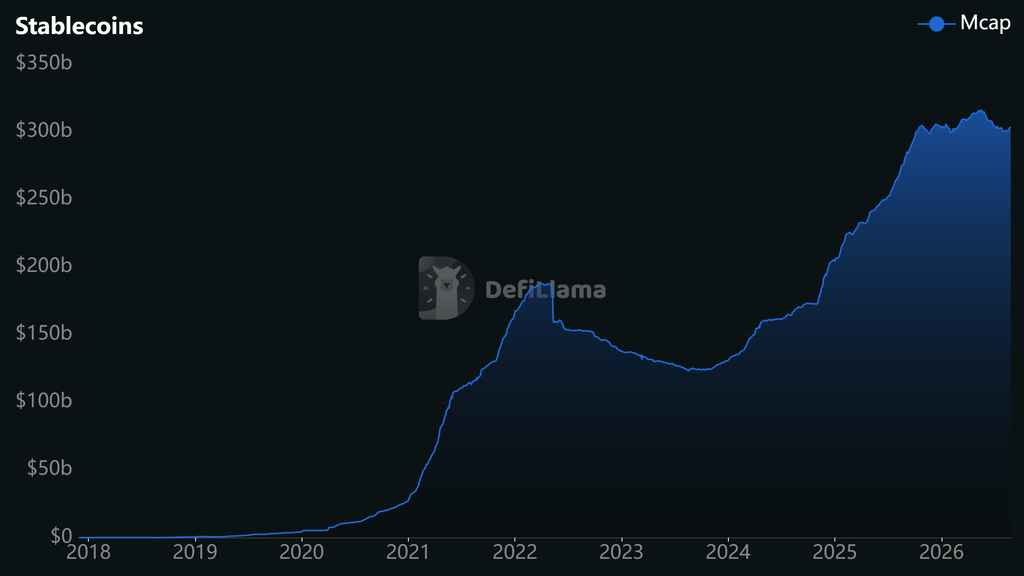
The global stablecoin market is currently worth roughly $304 billion, according to DefiLlama. USDT accounts for approximately $183 billion, while USDC represents about $74 billion of the market.
Data: DefiLlama. Figures accessed August 29, 2026.
Key Findings
- The BIS does not argue that stablecoins have no future. Its central concern is whether they can function as reliable money for payments at large scale.
- Three structural issues sit at the center of the BIS argument: singleness of money, interoperability between different networks and financial integrity.
- Tokenised bank deposits are emerging as an alternative model. They could bring programmability and tokenisation into the existing banking system while remaining anchored to commercial and central bank money.
- Stablecoin growth could have effects beyond crypto. Depending on how reserves are held, large-scale adoption could influence bank funding, government bond demand and monetary policy transmission.
- The debate is increasingly about financial infrastructure, not simply crypto versus banks. Stablecoins and tokenised deposits could ultimately coexist, serving different parts of the digital economy.
What the BIS Actually Said
At the Jackson Hole Economic Policy Symposium on August 28, 2026, BIS General Manager Pablo Hernández de Cos laid out a cautious assessment of stablecoins and their potential role in the future monetary system.
His argument was not that stablecoins are inherently unusable or that they will disappear. Instead, he questioned whether their current design can support payments at the scale expected from widely used forms of money.
According to Hernández de Cos, a monetary system needs to preserve several fundamental properties as it evolves technologically. In the case of stablecoins, the BIS sees three areas where significant challenges remain: the singleness of money, interoperability and financial integrity.
These concerns help explain why the BIS sees tokenised commercial bank deposits — rather than stablecoins alone — as a potentially stronger foundation for large-scale tokenised payments.
1. The Singleness of Money
The first issue raised by the BIS is the singleness of money — the principle that different forms of money denominated in the same currency should exchange at par.
In the traditional monetary system, a dollar held at one commercial bank is expected to have the same value as a dollar held at another. This works because commercial bank money is ultimately anchored to central bank money and supported by an institutional framework designed to maintain convertibility at par.
Stablecoins introduce a different structure. Even when two tokens are both designed to track the U.S. dollar, they are separate instruments issued by different entities, backed by different reserve structures and traded in different markets.
Hernández de Cos highlighted this issue using USDT and USDC as an example. A holder converting one dollar-denominated stablecoin into another cannot always assume that the exchange will occur at exactly one-for-one value. Market conditions, liquidity and confidence in the issuer can cause prices to deviate from their intended pegs.
This does not mean that stablecoins routinely fail to maintain their pegs. Rather, the BIS argument is that maintaining parity depends partly on market mechanisms and issuer-specific arrangements, creating a different form of monetary fragmentation from the one the existing banking system is designed to prevent.
2. The Interoperability Problem
Stablecoins can move quickly within blockchain networks, but the digital asset ecosystem does not operate as a single, unified payment infrastructure.
Different stablecoins exist across multiple blockchains and scaling networks, each with its own technical standards, settlement mechanisms and liquidity conditions. Moving value between these environments can require bridges, intermediaries or other cross-chain infrastructure.
From the BIS perspective, this fragmentation creates an interoperability challenge. A payment system intended to operate at large scale needs different participants and forms of money to interact reliably without forcing users to navigate separate technological ecosystems.
The issue becomes more important as stablecoins expand across chains. A dollar-denominated token on one network may represent the same nominal unit of account as a token on another, but the underlying infrastructure used to transfer and settle those assets can be fundamentally different.
Interoperability technology continues to develop, and cross-chain infrastructure could reduce some of these frictions over time. The BIS argument is therefore not that blockchain networks can never become interoperable, but that today's fragmented architecture does not yet provide the level of seamless integration expected from a monetary system operating at global scale.
3. Financial Integrity
A third concern raised by the BIS is financial integrity — particularly how anti-money laundering and counter-terrorist financing requirements can be applied consistently as stablecoins move through decentralised networks.
Public blockchains can allow users to hold and transfer digital assets through self-custodied wallets without relying on a traditional bank account. Transactions are recorded on-chain and can often be traced publicly, but wallet addresses do not necessarily reveal the real-world identity of the person controlling them.
This creates a different compliance environment from traditional finance. Regulated stablecoin issuers and exchanges can apply identity verification, transaction monitoring and other controls at identifiable entry and exit points. However, once tokens circulate through self-custodied wallets and decentralised applications, applying the same controls across every transaction becomes more complex.
The distinction is important. Blockchain transparency can provide investigators with transaction data that may not exist in cash-based systems, while blockchain analytics can help trace flows between addresses. At the same time, transparency at the transaction level does not automatically establish the identity behind every wallet.
The BIS therefore views effective regulation, supervision and compliance frameworks as important conditions for stablecoins to become part of a payment system operating at much greater scale.
Why the BIS Prefers Tokenised Deposits
The BIS sees tokenised commercial bank deposits as a different path toward digital money — one that attempts to combine the technological capabilities of tokenisation with the existing monetary system.
A tokenised deposit is essentially a digital representation of a claim on a commercial bank. Unlike a stablecoin issued against a separate pool of reserve assets, it remains part of the banking system and is denominated in the same money already used in bank accounts.
This distinction is central to the BIS argument. Commercial bank deposits operate within a two-tier monetary system in which private bank money is anchored to central bank money. If deposits can be tokenised without breaking that relationship, the technology could potentially support programmable payments and more efficient settlement while preserving the monetary framework already used at scale.
Tokenisation could also enable transactions in which the transfer of an asset and the corresponding payment occur together. Such arrangements — often described as atomic settlement — could reduce settlement risk in certain financial-market transactions.
The BIS points to Project Agorá as an example of this experimentation, bringing central banks and private-sector financial institutions together to explore how tokenised commercial bank money and central bank money could support cross-border payments on a programmable platform.
But tokenised deposits are not a finished solution.
They still face significant challenges involving interoperability, governance, legal certainty, cybersecurity and integration with existing banking infrastructure. Building a tokenised system that works across institutions and jurisdictions could therefore require substantial coordination between commercial banks, central banks, regulators and technology providers.
The BIS preference for tokenised deposits should consequently be understood as a choice of monetary architecture rather than a rejection of blockchain-based innovation itself: the institution is arguing that tokenisation may be more scalable when it remains anchored to the existing system of commercial and central bank money.
What Happens If Stablecoins Become Much Bigger?
Stablecoins are already deeply connected to traditional finance because the assets backing them generally sit outside the blockchain economy. As the sector grows, the composition of those reserves becomes increasingly important.
Stablecoin issuers can hold reserves in assets such as bank deposits, cash and short-term government securities. That means large changes in stablecoin demand can potentially shift where money is held within the conventional financial system rather than simply creating an isolated pool of digital capital.
Circle, for example, reports that USDC reserves include bank deposits, overnight U.S. Treasury repurchase agreements and short-dated U.S. Treasuries, illustrating how stablecoin reserves can create a direct link between blockchain-based money and traditional financial markets.
One possible channel involves bank funding. If households or businesses move significant amounts of money from bank deposits into stablecoins, banks could lose a relatively inexpensive source of funding. Depending on how issuers reinvest those funds, the money may return to the banking system in a different form — or move into government securities instead.
Another channel involves government debt markets. Stablecoin issuers that back their tokens with short-term government securities can become significant buyers of those assets as circulation expands. In the United States, this creates a direct connection between demand for dollar-denominated stablecoins and demand for short-term U.S. Treasury securities.
BIS researchers estimate that stablecoin issuers purchased approximately $35 billion in U.S. Treasury bills in 2025, illustrating how growth in dollar-denominated stablecoins can translate into meaningful demand for short-term government debt.
The implications are not necessarily one-directional. Greater demand for short-term government debt could place downward pressure on yields, while changes in bank funding conditions could affect the cost and availability of credit. The magnitude of these effects would depend on where stablecoin demand originates, how issuers structure their reserves and how the broader financial system responds.
The BIS analysis suggests that the overall macroeconomic effects could remain relatively modest under some scenarios. That is an important qualification: rapid stablecoin growth does not automatically imply a destabilisation of banks or government debt markets.
What it does mean is that stablecoins can no longer be viewed purely as crypto-market infrastructure. At sufficient scale, decisions about their reserves, regulation and use could increasingly interact with the same markets that influence credit conditions, government financing and monetary policy.
Stablecoins vs Tokenised Deposits: Not Necessarily a Winner-Takes-All Battle
The debate between stablecoins and tokenised deposits does not necessarily end with one model replacing the other.
Despite its preference for tokenised deposits as a foundation for large-scale payments, the BIS does not argue that stablecoins must disappear. Hernández de Cos acknowledged that different forms of digital money could coexist, particularly if they serve different purposes within the financial system.
Stablecoins already provide capabilities that are difficult to replicate through conventional banking infrastructure. They can move across blockchain-based markets around the clock, interact with decentralised applications and serve as settlement assets within crypto-native financial activity.
Tokenised deposits, by contrast, could be better positioned for use cases that require closer integration with regulated banks, central bank money and existing payment infrastructure.
This suggests that the future of digital money may be less about choosing a single winner and more about determining where each model works best.
Stablecoins could remain important in crypto-native markets and decentralised finance, while tokenised deposits could expand in institutional payments, banking and tokenised financial markets. The boundaries between those systems could also become less distinct if interoperability improves.
Regulation will play a major role in determining how that coexistence develops. Stablecoins used widely for payments would need credible redemption mechanisms, transparent reserve structures and regulatory frameworks capable of maintaining confidence in their value.
The larger question is therefore not simply whether stablecoins or tokenised deposits will win. It is whether multiple forms of tokenised money can coexist while remaining interoperable, trustworthy and connected to the broader monetary system.
What This Means for Crypto
The BIS debate highlights how far stablecoins have moved beyond their original role as a convenient way to transfer value between crypto exchanges.
They are increasingly becoming part of a much larger discussion about the future architecture of money.
For the crypto industry, the significance of the BIS position is not that stablecoins are about to disappear. Stablecoins already perform important functions across trading, settlement, decentralised finance and cross-border digital markets. The more important issue is what happens as those functions begin to overlap with payment systems traditionally dominated by banks.
If stablecoins continue to expand, questions around reserve quality, redemption, interoperability and regulatory oversight will become increasingly important. At the same time, banks are unlikely to remain passive. Tokenised deposits represent one way for the existing financial system to adopt some of the technological characteristics that made blockchain-based money attractive in the first place.
That could gradually narrow the technological gap between traditional finance and crypto-native infrastructure.
The result may not be a future divided neatly between “crypto money” and “bank money.” Instead, multiple forms of tokenised value could operate alongside one another, with different models competing on settlement efficiency, accessibility, programmability, regulatory certainty and trust.
The BIS has made its preferred direction clear: tokenisation anchored to commercial bank deposits and central bank money. The crypto ecosystem has developed a different model around stablecoins.
Which architecture ultimately achieves the greatest scale remains an open question.
What is already clear is that the stablecoin debate is no longer confined to crypto. It is becoming a debate about the infrastructure of money itself.
Sources & Methodology
This article is based primarily on remarks delivered by BIS General Manager Pablo Hernández de Cos at the Jackson Hole Economic Symposium on August 28, 2026.
The Crypto Public reviewed the original BIS speech alongside the BIS Annual Economic Report 2026, including its analysis of stablecoin market structure, reserve composition, interoperability and the potential macro-financial effects of wider stablecoin adoption. Reuters reporting was used as an additional independent source for the broader policy context surrounding the remarks.
The analysis distinguishes between statements and assessments made by the BIS and conclusions drawn by The Crypto Public. Where the future effects of stablecoin adoption remain uncertain, they are presented as scenarios rather than predictions.
- Bank for International Settlements — “Pushing the monetary frontier: stablecoins and tokenised deposits” (28 August 2026)
BIS — Original speech - Bank for International Settlements — “Anchoring trust in money: innovation beyond stablecoins” (23 June 2026)
BIS — Annual Economic Report, Chapter III - Reuters — “Stablecoins not a credible means of payment at scale, BIS chief says” (28 August 2026)
Reuters — Original report





















Responses (0 )