



Stablecoins are often described as digital versions of cash.
A user deposits one dollar, receives one dollar-denominated token, and expects to redeem that token for roughly the same amount later.
But behind that simple experience sits a much larger financial machine.
The reserves supporting major stablecoins such as USDC and USDT can include short-term U.S. Treasury securities, overnight repurchase agreements, bank deposits and other liquid assets. Those reserves can generate billions of dollars in income even while the token held by the user remains worth approximately $1.
That creates a fundamental question:
If stablecoin reserves generate yield, where does that yield actually go?
The answer reveals an important distinction between traditional stablecoins, yield-bearing digital dollars, tokenized Treasuries and DeFi lending products.
They may all look like digital dollars on-chain, but the economics underneath them can be very different.
Key Findings
- Stablecoin issuers can earn income by investing reserve assets in short-duration, liquid instruments such as U.S. Treasury securities and Treasury-backed repurchase agreements.
- Circle reported $668 million in reserve income in Q2 2026, highlighting how important reserve returns are to USDC's economics.
- USDC holders do not automatically receive the investment return generated by the reserves supporting their tokens.
- Tether's reserve model also includes substantial U.S. Treasury exposure, but its overall asset mix and corporate economics differ from Circle's.
- Yield-bearing products such as tokenized Treasuries use a different model in which some of the return generated by underlying assets can accrue to eligible token holders.
- DeFi lending yield is different again: it generally depends on borrowers paying interest for access to capital.
- Falling interest rates can pressure reserve income even if stablecoin circulation continues growing.
The important takeaway is that “stablecoin yield” is not one single source of return.
To understand the risk and economics of a digital-dollar product, investors and users need to understand what generates its yield — and who ultimately receives it.
The Basic Stablecoin Business Model
Consider a simplified example.
A user provides $1,000 to a stablecoin issuer and receives 1,000 tokens designed to remain worth approximately one dollar each.
The issuer now has both an asset and a liability.
The $1,000 received from the user becomes part of the reserve assets backing the stablecoin. At the same time, the 1,000 outstanding tokens represent a redemption obligation.
But the issuer does not necessarily leave that $1,000 sitting idle.
Depending on the stablecoin and its reserve policy, some of the money can be held in highly liquid, relatively low-risk instruments that generate interest.
This is where the economics become important.
Suppose, purely as an illustration, that $1,000 of reserves earned 4% annually.
The reserve assets would generate approximately $40 of gross annual income.
The token holder, however, would still generally hold 1,000 tokens worth approximately $1 each.
The token itself does not need to appreciate to $1.04 simply because the reserve assets generated income.
This separation between the value of the stablecoin and the return generated by its reserves is one of the most important concepts in the stablecoin business.
At sufficient scale, even relatively modest yields on enormous reserve portfolios can generate substantial income.
How USDC Generates Reserve Income
Circle provides one of the clearest examples because it is publicly listed and reports detailed financial results.
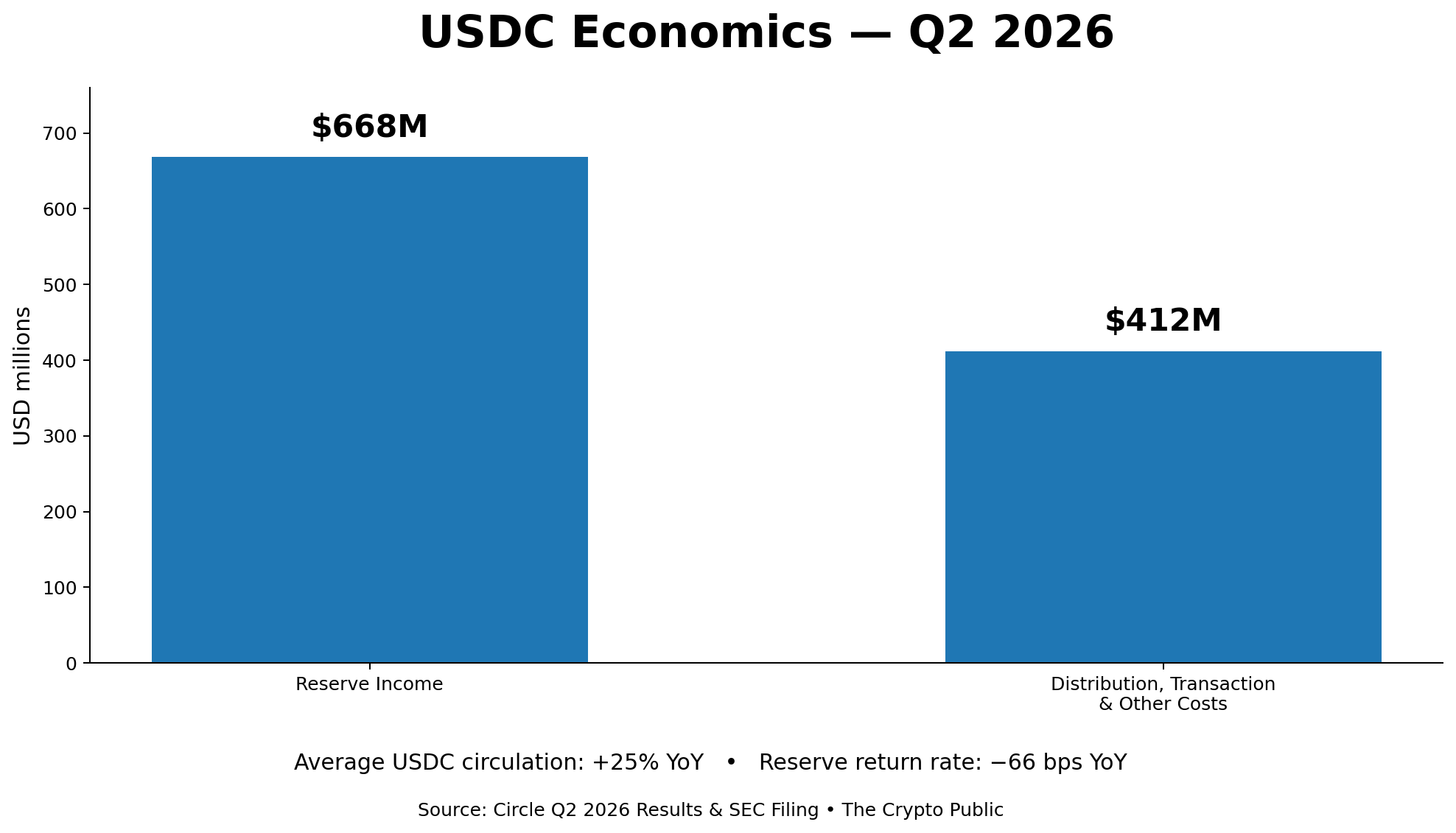
According to Circle's second-quarter 2026 results, the company generated $668 million in reserve income during the quarter, up 5% year over year. Circle said the increase was primarily driven by a 25% increase in average USDC in circulation, partially offset by a 66-basis-point decline in the reserve return rate.
That relationship is fundamental to USDC's economics.
More USDC in circulation generally means more assets need to be held in reserve.
A larger reserve base can produce more income.
But the amount of income also depends on the yield available on those assets.
Circle states that USDC reserves can include bank deposits, overnight U.S. Treasury repurchase agreements and short-dated U.S. Treasury securities. A significant portion of the reserve portfolio is held through the Circle Reserve Fund, a government money market fund managed by BlackRock.
This means USDC's economics are indirectly connected to the U.S. interest-rate environment.
When short-term rates are relatively high, a large portfolio of short-duration government securities can generate substantial income.
When those rates decline, the same reserve base may generate less.
Circle's 2026 results already demonstrate this dynamic.
Growth in USDC circulation helped reserve income, while declining reserve yields worked in the opposite direction.
Reserve Income Is Not the Same as Profit
There is another important distinction.
Hundreds of millions of dollars in reserve income do not automatically translate into hundreds of millions of dollars in profit for the issuer.
Operating a global stablecoin network carries substantial expenses.
Circle, for example, has distribution arrangements with companies that help make USDC available across exchanges, wallets and other platforms.
In Q2 2026, Circle reported $412 million in distribution, transaction and other costs, up 64% year over year.
This creates another layer in the stablecoin economy.
Reserve assets generate income.
Part of that economic value can then be used for distribution agreements, operating expenses, technology, compliance and other corporate costs.
What remains contributes to the issuer's broader financial performance.
So the business is more complicated than simply collecting Treasury interest.
Scale matters.
Interest rates matter.
Distribution economics matter.
And competition for users matters.
How Tether's Model Differs
USDT is built around the same basic promise of maintaining a stable value, but Tether's reserve structure and corporate model are not identical to Circle's.
Tether reported approximately $1.04 billion in net profit for the first quarter of 2026, while reporting roughly $8.23 billion in excess reserves above liabilities associated with issued tokens.
The company has repeatedly emphasized its large exposure to U.S. Treasury securities and other liquid reserve assets.
That Treasury exposure is important because it demonstrates how large stablecoin issuers have become significant participants in traditional fixed-income markets.
But Tether's reserves also extend beyond a single category of government securities.
This makes comparisons between Tether's corporate profit and Circle's reserve income imperfect.
They measure different things and come from companies with different reserve structures, expenses and business activities.
The broader principle, however, remains the same:
A stablecoin can remain worth approximately $1 while the assets supporting it generate substantial economic returns elsewhere in the system.
The Yield Stablecoin Holders Usually Don't Receive
This leads to the central question.
If a user's dollars help create a reserve portfolio that earns interest, why doesn't the user's stablecoin balance automatically grow?
Because conventional fiat-backed stablecoins are generally designed primarily as stable-value payment and settlement instruments, not as direct claims on all investment income generated by their reserves.
The user receives utility.
They can transfer the token across supported blockchain networks, trade it, use it as collateral, settle transactions or potentially redeem it according to the issuer's terms.
The reserve portfolio serves a different purpose: supporting liquidity and the issuer's ability to meet redemption obligations while operating within the product's reserve framework.
The economic return generated by those reserves therefore does not necessarily belong directly to the token holder.
That design is increasingly important because a second category of digital-dollar products is challenging the model.
What Yield-Bearing Digital Dollars Change
Tokenized Treasury products introduce a fundamentally different proposition.
Instead of providing only a token designed to maintain a stable dollar value, these products can give eligible holders economic exposure to income generated by underlying assets.
Ondo Finance's USDY provides an example.
USDY is backed by assets including short-term U.S. Treasuries and bank deposits. Its structure is designed so that yield from the underlying assets can be reflected in the product for eligible holders.
That creates a very different value proposition.
With a conventional stablecoin, a user may primarily receive dollar stability and blockchain-based utility.
With a tokenized Treasury product, the user may seek both dollar-denominated exposure and the return generated by the underlying securities.
The distinction may appear subtle when both assets exist as tokens on a blockchain.
Economically, it is significant.
Stablecoin Yield Is Not One Thing
The growth of digital dollars has created a tendency to describe very different forms of return using the same word: yield.
But the source matters.
There are at least three distinct mechanisms.
Reserve yield comes from assets held behind a stablecoin, such as Treasury securities or repurchase agreements. Depending on the structure, that income may primarily accrue within the issuer's business rather than directly to token holders.
Tokenized Treasury yield originates from government securities or related cash-management assets and is structured to pass economic exposure to eligible investors.
DeFi lending yield generally originates from borrowers willing to pay interest to access liquidity.
These mechanisms carry different counterparties, structures, liquidity characteristics and risks.
A 4% return generated by Treasury bills is therefore economically different from a 4% lending rate generated by leveraged demand for a crypto asset.
Looking only at the advertised percentage can hide the most important information.
The better question is:
Who is paying the yield, and why?
What Happens When Interest Rates Fall?
This may become one of the most important questions for the stablecoin industry.
The extraordinary growth of fiat-backed stablecoins has occurred during a period in which short-term U.S. government securities have generated meaningful yields.
That environment has made enormous pools of stablecoin reserves economically valuable.
But the model is sensitive to rates.
Circle's Q2 2026 results provide a real-world example.
Average USDC circulation increased substantially, but the reserve return rate declined by 66 basis points. Circle estimated that the lower reserve return rate created a roughly $113.9 million negative impact on reserve income compared with the prior-year period.
This reveals an important tension.
Stablecoin circulation can grow while the amount of income generated per dollar of reserves falls.
If rates decline significantly, issuers may therefore need much larger circulation to maintain the same level of reserve income.
The opposite can also occur.
Higher short-term rates can make existing reserve balances more profitable without requiring equivalent growth in stablecoin supply.
Stablecoin economics are therefore connected not only to crypto adoption, but also to monetary policy.
Stablecoins Are Becoming Part of the Treasury Market
There is another consequence of this model.
As stablecoin supply grows, issuers need increasingly large pools of reserve assets.
For major fiat-backed stablecoins, that can translate into significant demand for short-term U.S. government debt and related instruments.
The International Monetary Fund has highlighted the increasing connections between stablecoins and traditional financial markets, including their exposure to short-term government securities and repo markets.
At the same time, tokenized Treasury products are expanding the connection from another direction.
Instead of Treasuries sitting behind a stablecoin, Treasury exposure itself can be represented on-chain.
That means two parallel models are developing:
Treasuries backing digital dollars.
And:
Treasuries becoming digital assets themselves.
The distinction could become increasingly important as stablecoins, tokenized deposits, money-market funds and tokenized government securities compete for similar pools of digital liquidity.
Why This Matters for the Future of Digital Dollars
Stablecoins solved an important problem for crypto markets: moving dollar-denominated value across blockchain networks without requiring every transaction to pass through the traditional banking system.
But the next stage of competition may be about more than stability.
Users can increasingly ask:
Why hold a digital dollar that generates no direct yield if another regulated or appropriately structured product can provide dollar exposure and pass through returns from underlying assets?
There is no universal answer.
A non-yield-bearing stablecoin may offer greater liquidity, wider exchange support, deeper DeFi integration or simpler payment utility.
A yield-bearing product may introduce eligibility restrictions, securities-law considerations, different liquidity characteristics or additional structural complexity.
The products therefore do not necessarily compete on yield alone.
But the existence of alternatives changes the economics of holding digital dollars.
The market is moving from a world dominated by one question —
“Can this token maintain one dollar?”
— toward a more complicated one:
“What happens to the money while the token maintains one dollar?”
What to Watch
The Crypto Public will monitor several indicators as the digital-dollar market evolves.
Stablecoin supply. Growing USDC and USDT circulation increases the scale of reserve assets behind the market.
Short-term interest rates. Changes in Treasury and money-market yields can materially affect reserve income.
Reserve composition. The liquidity and risk profile of assets backing stablecoins remains fundamental to their ability to meet redemptions.
Distribution costs. Stablecoin growth can be expensive, and agreements with exchanges, wallets and other distribution partners can consume a significant portion of issuer economics.
Tokenized Treasury adoption. Growth in products that pass underlying yield to investors could create a more direct alternative to holding non-yield-bearing digital dollars.
Regulation. Stablecoin and securities rules will help determine which products can offer yield, to whom and under what structure.
The Bigger Picture for Digital Dollars
Stablecoins may look simple from the user's perspective: one token, one dollar. But behind that simplicity sits a growing financial system built around reserves, interest rates and liquidity.
USDC and USDT show how reserve assets can generate substantial income without automatically passing that return to token holders. Tokenized Treasuries and DeFi products introduce different models, where yield can come from underlying securities or demand for borrowed capital.
As these markets converge, simply asking how much yield a digital-dollar product offers is not enough.
The more important questions are where that yield comes from, what risks produce it, and who ultimately receives it.
This analysis uses publicly available company disclosures, reserve information, regulatory filings and institutional research.
Circle figures refer to the company's Q2 2026 financial results and related disclosures. Reserve income should not be interpreted as equivalent to net income because Circle incurs substantial distribution, transaction, operating and other expenses.
Tether figures are based on the company's Q1 2026 reporting and should not be compared directly with Circle's reserve-income figures because the companies have different corporate structures, asset mixes and reporting frameworks.
Descriptions of reserve structures reflect publicly disclosed information at the time of review. Reserve composition, stablecoin circulation, interest rates and product structures can change over time.
Examples involving hypothetical interest rates are illustrative and are not estimates of actual issuer returns.
Yield-bearing products and tokenized Treasury instruments may have different legal structures, eligibility requirements and risks from conventional stablecoins.
This article is for informational purposes only and does not constitute investment advice.
Primary Sources & Data
Last data review: August 30, 2026
The Crypto Public may update this research as reserve structures, interest rates, stablecoin circulation and the tokenized Treasury market evolve.




















Responses (0 )