



Bitcoin is designed so that no single company, government or institution controls the network. Yet the process that actually adds new blocks to the blockchain is far from evenly distributed.
Bitcoin miners around the world contribute enormous amounts of computing power to compete for the right to produce the next block. Most, however, do not compete alone. They connect their machines to mining pools, combining hashrate with other miners in exchange for more predictable payouts.
That structure has created an important distinction that is often lost in discussions about Bitcoin decentralization: the largest mining pools can account for a substantial share of block production without necessarily owning the machines producing all of that computing power.
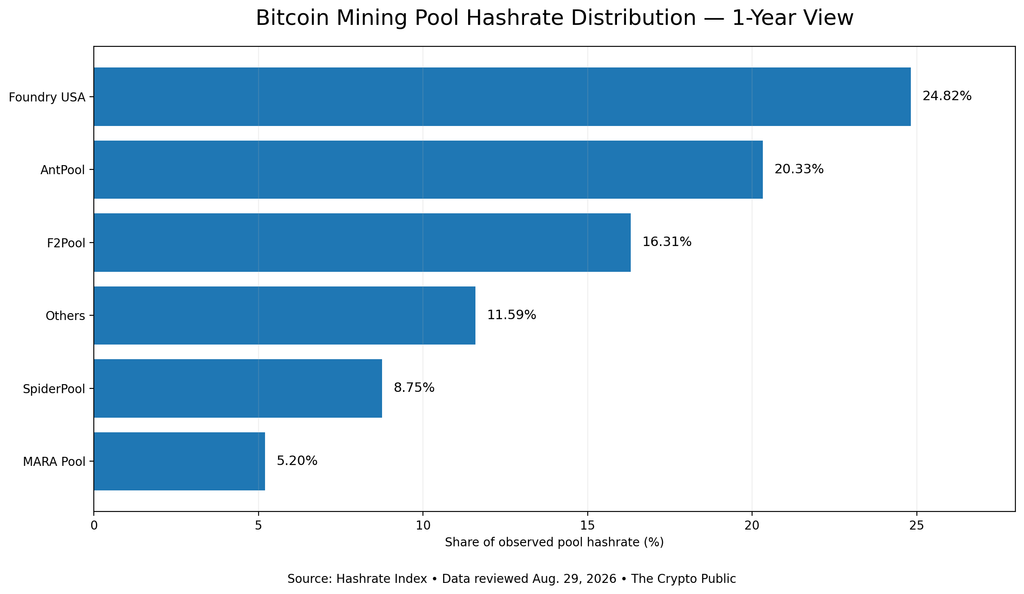
Recent mining data illustrates just how concentrated the pool layer can appear. Hashrate Index data shows Foundry USA, AntPool and F2Pool as the three largest pools over its displayed one-year distribution, accounting for roughly 24.82%, 20.33% and 16.31% respectively. Together, that represents approximately 61.46% of the observed one-year distribution.
But those numbers do not mean three pool operators own 61.46% of Bitcoin’s mining hardware. Mining pools coordinate work submitted by participating miners, making the relationship between pool concentration, miner ownership and actual control of the network more complicated than headline market-share figures suggest.
That distinction matters as Bitcoin’s mining industry continues to evolve. Major industry participants including AntPool, F2Pool, Foundry, MARA Foundation and SpiderPool joined the Stratum V2 Working Group in 2026, an initiative developing an open mining protocol designed to improve efficiency, privacy, security and miner autonomy.
So who really mines Bitcoin — and how concentrated is the network in practice?
The Crypto Public examines the mining pools producing Bitcoin’s blocks, the miners operating beneath them, and what the data actually tells us about decentralization and control.
Key Findings
- Bitcoin mining is globally distributed, but block production is concentrated among a relatively small number of mining pools.
- Foundry USA, AntPool and F2Pool together account for a large share of observed mining-pool activity, making pool concentration an important part of Bitcoin’s decentralization debate.
- Mining-pool market share is not the same as ownership of Bitcoin’s mining hardware. Pools coordinate hashrate contributed by miners that may be independently owned and geographically distributed.
- Concentration still matters. Mining pools can influence block construction and transaction selection, which means the distribution of decision-making power is as important as the distribution of physical mining machines.
- New mining protocols such as Stratum V2 are designed to give individual miners greater autonomy, potentially reducing some of the dependence on pool operators in block construction.
Who Is Actually Mining Bitcoin?
Bitcoin mining is performed by specialized computers that repeatedly calculate hashes in an attempt to produce a valid block. The more computing power — or hashrate — a miner contributes, the greater its statistical chance of participating in successful block production.
In practice, however, most miners do not mine independently.
Instead, they connect their machines to mining pools. A pool coordinates the computing power contributed by many participants, assigns mining work and distributes rewards according to its payout structure when the pool successfully produces a block.
This creates two different layers that are important when evaluating Bitcoin mining concentration.
The first is the physical mining layer: the companies and independent operators that own or operate ASIC machines, mining facilities and electrical infrastructure.
The second is the pool coordination layer: the mining pools that aggregate hashrate from participating miners and coordinate the process of producing blocks.
A mining company can operate its own machines while directing some or all of its hashrate to an external pool. Likewise, a large pool can coordinate computing power supplied by many miners without owning the underlying hardware.
This is why a pool producing 20% of observed Bitcoin blocks should not automatically be interpreted as a single company owning 20% of the Bitcoin network’s mining equipment.
At the same time, pool concentration should not be dismissed. The entity coordinating a pool can play an important role in how candidate blocks are constructed and which transactions are included. Understanding Bitcoin’s mining decentralization therefore requires looking at both who owns the hashrate and who coordinates it.
That distinction provides the foundation for interpreting mining-pool market-share data correctly.
The Largest Bitcoin Mining Pools
Bitcoin’s mining-pool landscape is dominated by a small group of large operators, although their relative shares change continuously as miners redirect hashrate and blocks are discovered.
Hashrate Index’s one-year pool distribution, reviewed by The Crypto Public on August 29, 2026, shows Foundry USA accounting for approximately 24.82% of observed pool hashrate, followed by AntPool at 20.33% and F2Pool at 16.31%.
Based on The Crypto Public’s calculation of those figures, the three largest pools together represent approximately 61.46% of the one-year distribution.
The concentration extends further down the ranking. SpiderPool accounts for approximately 8.75%, while MARA Pool represents about 5.20% over the same one-year view.
These figures provide a useful picture of concentration at the pool layer, but they should not be interpreted as a direct map of mining-machine ownership. As explained above, pools can coordinate hashrate contributed by multiple independent mining operations.
The measurement window also matters. Short-term pool shares can move significantly as blocks are discovered and miners redirect computing power. For that reason, The Crypto Public uses the one-year distribution here to provide a more stable view of mining-pool concentration rather than relying on a single day or week.
The result is still striking: a majority of observed Bitcoin mining-pool hashrate is coordinated through just three pools. The more difficult question is what that concentration allows those pool operators to control — and what remains in the hands of the miners themselves.
Mining Pool ≠ Mining Company
One of the easiest mistakes to make when reading Bitcoin mining statistics is to treat a mining pool as if it were a single mining company.
They are not the same thing.
A mining company owns or operates mining infrastructure: ASIC machines, data centers, power connections and other equipment used to generate hashrate. A mining pool, by contrast, coordinates computing power contributed by miners and distributes rewards according to the pool’s payout system.
The distinction becomes clearer when looking at real-world participants. Large publicly traded miners can operate substantial amounts of their own computing infrastructure while choosing how that hashrate is directed. Independent miners can do the same on a much smaller scale.
As a result, the hashrate attributed to a pool such as Foundry USA, AntPool or F2Pool should not automatically be interpreted as hashrate physically owned by the pool operator.
This distinction changes how mining concentration should be measured. Hardware ownership tells us who controls physical computing resources, while pool concentration tells us where that computing power is being coordinated for block production.
The two can overlap, but they answer different questions.
That does not make pool concentration irrelevant. Pool operators have historically played an important role in constructing candidate blocks and coordinating the work miners perform. If a large share of network hashrate relies on a small number of coordinators, the distribution of that coordination becomes an important part of Bitcoin’s decentralization discussion.
At the same time, miners are not necessarily permanently tied to one pool. Hashrate can be redirected, meaning pool market share can change without the underlying mining machines physically moving.
Understanding that separation is essential before asking whether Bitcoin mining is becoming more centralized.
Why Miners Join Pools in the First Place
Bitcoin mining is probabilistic. A miner can contribute computing power to the network for a long period without independently producing a block, particularly if its hashrate represents only a small fraction of the total network.
For large industrial operations, that uncertainty can make revenue less predictable. For smaller miners, successfully finding a block through solo mining can be an extremely infrequent event.
Mining pools address this problem by combining the hashrate of many participants. Instead of each miner independently competing for an entire block reward, participants contribute work to a shared pool and receive payouts according to the pool’s reward system.
The fundamental trade-off is variance.
Solo mining can potentially produce a large payout when a miner successfully finds a block, but the timing of that event is uncertain. Pool mining generally replaces some of that uncertainty with smaller, more frequent and more predictable payouts.
This economic incentive helps explain why mining pools have become such an important layer of Bitcoin’s infrastructure. Miners are not necessarily choosing pools because they want block production to become concentrated. They are responding to the economics of a system in which successful block discovery is probabilistic.
Pool size can also matter. A pool representing a larger share of network hashrate is statistically expected to find blocks more frequently than a much smaller pool, although individual results can vary over shorter periods.
That creates an important tension. The same mechanism that can make mining income more predictable for individual participants can also concentrate block coordination among a relatively small number of pools.
The next question, therefore, is not simply why pools exist — but how concentrated that coordination has become.
How Concentrated Is Bitcoin Mining?
Mining-pool concentration becomes clearer when the largest operators are examined together rather than individually.
Based on the one-year Hashrate Index distribution reviewed by The Crypto Public on August 29, 2026, Foundry USA accounted for approximately 24.82% of observed pool hashrate, AntPool 20.33%, F2Pool 16.31%, SpiderPool 8.75% and MARA Pool 5.20%.
Using those figures, The Crypto Public calculates that Foundry USA and AntPool together represented approximately 45.15% of the observed one-year distribution. Adding F2Pool increases the combined share of the three largest pools to approximately 61.46%, while the five named pools analyzed here together account for approximately 75.41%.
Those numbers show substantial concentration at the coordination layer of Bitcoin mining. They do not, however, mean that five companies own three-quarters of Bitcoin’s mining machines or independently control an equivalent share of the network.
This distinction becomes particularly important when discussing Bitcoin’s often-cited 51% threshold.
In proof-of-work systems, an entity controlling a majority of network hashrate could potentially gain significant influence over the ordering of recent transactions and attempt actions such as reorganizing blocks or double-spending its own transactions. But majority hashrate does not provide unlimited control over Bitcoin.
It would not, for example, allow an attacker to arbitrarily create bitcoin beyond the protocol’s issuance rules, spend coins without the required signatures or unilaterally rewrite Bitcoin’s consensus rules for nodes that continue enforcing them.
More importantly, adding the market shares of independent mining pools does not demonstrate that those pools are coordinating with one another. Concentration statistics describe the structure of the mining market; they are not evidence of collusion.
The data therefore points to a more nuanced conclusion. Bitcoin’s pool layer is clearly concentrated, but translating that concentration into actual network control requires understanding who controls block construction, how quickly miners can redirect hashrate and whether multiple pools are acting independently.
Those questions matter more than any single market-share percentage.
Does Mining Pool Concentration Threaten Bitcoin?
Mining-pool concentration creates legitimate questions about Bitcoin’s decentralization, but the level of risk depends on what kind of control is actually concentrated.
A pool that coordinates a large share of hashrate can play an important role in block construction. Depending on the mining protocol and pool configuration being used, the pool operator may determine which transactions are included in candidate blocks and distribute work to the miners connected to it.
This creates several potential concerns. A sufficiently dominant coordinator could theoretically attempt to censor certain transactions, while extreme concentration could increase concerns about block reorganizations or other forms of majority-hashrate behavior.
But mining pools also differ from permanently controlled blocks of computing power.
The miners supplying hashrate to a pool can potentially redirect that computing power elsewhere. If a pool behaves in a way miners consider harmful, uneconomic or incompatible with their interests, some participants can switch to another pool without physically relocating their mining equipment.
That ability does not eliminate concentration risk. Switching pools requires miners to notice the behavior, decide to respond and have viable alternatives available. Large mining operations may also have commercial, technical or operational reasons for choosing particular pools.
There is another important distinction: Bitcoin’s security is not determined by miners alone.
Full nodes independently validate blocks against Bitcoin’s consensus rules. Hashrate helps determine which valid chain accumulates the most proof of work, but miners cannot simply produce blocks that violate rules enforced by validating nodes and expect those blocks to be accepted by those nodes.
This distinction is part of Bitcoin’s broader power structure, where miners, full nodes, developers, users and businesses exercise different forms of influence without any one group having unilateral control over the entire network.
Mining concentration should therefore be viewed as one component of Bitcoin’s broader decentralization model rather than a single metric capable of answering whether Bitcoin is “centralized” or “decentralized.”
The more useful questions are narrower: How concentrated is block coordination? Who chooses the transactions that miners work on? How easily can miners change coordinators? And are technological changes shifting more decision-making back toward individual miners?
That last question is particularly important because Bitcoin mining protocols themselves are beginning to evolve.
What Stratum V2 Changes
The concentration debate becomes more complicated when the mining protocol itself begins to change who can participate in constructing blocks.
Traditional pooled mining has generally given pool operators an important role in creating block templates and assigning work to participating miners. This means that even when the physical hashrate comes from many independent operators, some decisions involved in block construction can remain concentrated at the pool level.
Stratum V2 is designed to change parts of that relationship.
The open mining protocol introduces a framework known as Job Declaration, which can allow miners to construct their own block templates and propose them to a pool rather than relying exclusively on templates created by the pool operator.
This distinction matters because block construction determines which valid transactions a miner attempts to include in a block. Giving miners greater control over that process can reduce dependence on a pool operator for transaction selection while still allowing miners to participate in pooled mining and receive more predictable payouts.
Major industry participants including AntPool, F2Pool, Foundry, MARA Foundation and SpiderPool joined the Stratum V2 Working Group in 2026, reflecting broader industry involvement in the protocol’s development.
Stratum V2 should not, however, be interpreted as an automatic solution to mining centralization. The existence of the protocol does not mean every miner connected to a participating pool is already constructing its own block templates, and adoption can vary across pools, software and mining operations.
It also does not redistribute ownership of ASIC machines or electricity infrastructure. Instead, it addresses a narrower but important question: who gets to participate in deciding what goes into the blocks that mining hardware is working to produce?
If miner-selected block construction becomes widely adopted, Bitcoin could retain the economic advantages of pooled mining while distributing more of the block-construction process away from centralized pool coordinators.
That makes Stratum V2 adoption an important metric for The Crypto Public to track as this research page is updated over time.
What Happens If a Mining Pool Becomes Too Powerful?
A mining pool becoming unusually large does not automatically mean that Bitcoin has been compromised. But as more hashrate is coordinated through a single operator, the potential consequences of that operator’s decisions become more significant.
One concern is transaction censorship. If a pool controls block-template construction, it could choose not to include certain valid transactions in the blocks it attempts to produce. Other miners and pools could still include those transactions, but censorship could become more disruptive as the censoring pool’s share of block production increases.
A more extreme scenario involves majority hashrate. An actor able to consistently control more than half of Bitcoin’s total mining power could potentially attempt to reorganize recent blocks and use that capability in attacks such as reversing its own transactions after they had been confirmed.
Even majority hashrate has important limits. It does not reveal private keys, allow arbitrary spending from other users’ wallets or give miners the ability to create bitcoin outside the consensus rules enforced by validating nodes.
Pool concentration also introduces another complication: a pool’s reported share is not necessarily permanently controlled hashrate.
When independent miners contribute computing power to a pool, some of that hashrate can potentially move elsewhere if the pool behaves maliciously, becomes unreliable or offers less attractive economic conditions. A pool approaching a dangerous level of concentration could therefore create incentives for miners to redirect their machines.
That response should not be assumed to happen instantly or universally. Mining operations make decisions based on payout structures, infrastructure, latency, reliability, contractual relationships and other operational considerations. The ability to switch pools is therefore a potential counterweight to concentration — not a guarantee against it.
This is why a snapshot showing several large pools cannot by itself establish that Bitcoin faces an imminent majority attack. The relevant issue is not only how much hashrate appears under a pool’s name, but how much of that hashrate the operator can actually coordinate, for how long, and for what purpose.
Monitoring mining concentration therefore requires more than watching for a single pool to cross an arbitrary percentage. It requires examining how block construction, miner autonomy and hashrate distribution change together.
How Bitcoin Mining Concentration Has Changed Over Time
Bitcoin’s largest mining pools have changed significantly over time, even as concentration at the top of the market has remained an important feature of the industry.
At the beginning of 2021, the pool landscape looked very different from today. Hashrate Index data showed F2Pool as the largest pool in a seven-day average with approximately 16.3% of network hashrate, followed by Poolin at 14.9% and Binance Pool at 11.9%. Foundry had not yet emerged as the dominant pool it would later become.
By January 2022, that structure had already shifted. Hashrate Index data showed Foundry moving into first place with approximately 16.57%, followed by AntPool at 15.73% and F2Pool at 15.07%. The shift came during a broader restructuring of the mining industry in 2021, as substantial Bitcoin mining capacity moved out of China and the geographic distribution of global hashrate changed.
Concentration at the top became considerably more visible in subsequent years. A Hashrate Index snapshot from May 2024 showed AntPool and Foundry accounting for approximately 25.9% and 24.9% respectively on a seven-day average — a combined 50.8% of observed pool market share during that measurement window.
Full-year data tells a similar story. Hashrate Index reported that Foundry accounted for approximately 30% of blocks mined in 2024, while AntPool represented approximately 24%. Together, the two largest pools accounted for roughly 54% of the year’s reported pool market share.
The composition continued to evolve in 2025. Hashrate Index’s year-end report placed Foundry at approximately 30.1%, AntPool at 18.3%, ViaBTC at 13.0%, F2Pool at 10.0% and SpiderPool at 8.8%.
The important lesson is not that the same companies have permanently controlled Bitcoin mining. In fact, the rankings demonstrate the opposite: pools can gain or lose substantial market share as miners, geography, economics and infrastructure change.
What has persisted is the broader concentration of block coordination among a relatively small number of large pools.
Bitcoin mining concentration is therefore better understood as a dynamic structure than a fixed hierarchy. The dominant pools can change, while the question of how much block production is coordinated through the largest operators remains relevant.
This is one reason The Crypto Public will treat this article as a living research page. Pool rankings, concentration metrics and protocol adoption can be updated as the mining market evolves.
What to Watch
Bitcoin mining concentration cannot be understood from a single snapshot. Pool rankings can change, network hashrate can expand or contract, and new mining technologies can alter how decision-making is distributed between miners and pool operators.
For that reason, The Crypto Public will monitor several indicators when updating this research.
1. Top-three mining pool concentration
The combined share of the three largest pools provides a simple way to track whether block coordination is becoming more concentrated or more distributed over time. As of the one-year distribution reviewed for this article, the top three pools accounted for approximately 61.46%.
2. Concentration among major named pools
A broader measure captures whether hashrate is merely shifting between the largest operators or spreading further across the mining-pool market. The five named pools analyzed here represented approximately 75.41% of the observed one-year distribution.
3. Changes in individual pool market share
The identities of the largest pools matter as much as the aggregate concentration figures. Historical data shows that dominant pools can lose their position while new operators rise rapidly.
4. Stratum V2 adoption
Market share alone does not reveal who constructs candidate blocks. Adoption of Stratum V2, particularly its Job Declaration framework, could give individual miners greater control over block construction and change the decentralization implications of a highly concentrated pool market.
5. Network hashrate and the underlying mining industry
Pool concentration should also be considered alongside changes in Bitcoin’s total network hashrate and the companies and independent miners supplying that computing power. An increase in total network hashrate can occur even while pool coordination remains concentrated, just as changes in pool rankings do not necessarily mean the underlying mining hardware has physically moved.
These indicators will allow future updates to distinguish between changes in physical mining capacity, pool coordination and block-construction authority rather than treating all three as the same measure of decentralization.
Last data review: August 29, 2026.
Sources & Methodology
This article is based primarily on Bitcoin mining-pool distribution data published by Hashrate Index, together with official documentation from the Stratum V2 project and supporting historical mining-industry data.
For the current mining-pool comparison, The Crypto Public uses the one-year pool distribution reviewed on August 29, 2026, rather than a short-term daily or weekly snapshot. Mining-pool shares can fluctuate as blocks are discovered and miners redirect hashrate, so a longer measurement window reduces the influence of short-term fluctuations and provides a broader view of pool concentration over time.
The concentration figures cited in this article were calculated by The Crypto Public from the underlying pool-share data. Based on the dataset used for this analysis, the two largest pools represented approximately 45.15%, the three largest approximately 61.46%, and the five named pools analyzed here approximately 75.41% of the observed one-year distribution.
Mining-pool share is treated separately from ownership of physical mining infrastructure. A pool can coordinate hashrate contributed by multiple independent miners, meaning the percentage attributed to a pool should not automatically be interpreted as the percentage of Bitcoin mining hardware owned by that pool operator.
Historical figures are used to illustrate how the mining-pool landscape has changed over time. Because some historical sources use different measurement windows — including seven-day snapshots and full-year block-production data — The Crypto Public does not treat those observations as a single directly comparable time series. Each historical figure should be interpreted within the measurement period reported by its source.
Information about Stratum V2 is based on official documentation and announcements published by the project. Participation in the Stratum V2 Working Group or support for the protocol should not be interpreted as evidence that every miner connected to a participating pool is already using miner-selected block construction.
This research distinguishes between observed data, calculations performed by The Crypto Public and analytical conclusions drawn from those findings. Pool concentration is not treated as evidence that independently operated mining pools are coordinating or colluding with one another.
Because mining-pool distribution and protocol adoption can change over time, this article is intended to be periodically updated while retaining the same permanent URL.
Primary Sources & Data
The primary datasets and technical documentation used in this analysis are linked directly at the relevant claims above. They include Hashrate Index’s current and historical mining-pool data, the Bitcoin Developer Guide, and official Stratum V2 documentation.



















Responses (0 )